1 4 vs. 3 8 Air Compressor Hose: Which Fits Your Setup Better?
Selecting the correct hose diameter dictates pneumatic tool performance and pressure drop. Understanding internal dimensions helps optimize your compressed air delivery system.

Choose the 1/4-inch hose for lightweight trim work and maximum portability. Opt for the 3/8-inch hose when running high-demand pneumatic tools requiring sustained airflow.
Compare all top models in our Best Air Compressor: Top Picks for Every Garage & Roadside.
Side-by-Side Breakdown
| Criteria | 1 4 | 3 8 Air Compressor Hose | Edge |
|---|---|---|---|
| Peak Performance & Output | Lower CFM delivery at distance | Higher CFM delivery at distance | 3 8 Air Compressor Hose |
| Duty Cycle & Consistency | Moderate pressure drop over 50 feet | Minimal pressure drop over 50 feet | 3 8 Air Compressor Hose |
| Operating Noise & Vibration | Standard operational acoustics | Standard operational acoustics | Tie |
| Portability & Footprint | Extremely lightweight and compact coil | Heavier and bulkier coil footprint | 1 4 |
| Maintenance & Service Life | Standard abrasion resistance profile | Reinforced wall durability profile | 3 8 Air Compressor Hose |
| Power Requirements | Works well with standard portable tanks | Requires adequate compressor tank capacity | Tie |
| Best Ideal Use-Case | Brad nailers and light inflation tasks | Impact wrenches and framing nailers | 3 8 Air Compressor Hose |
Fundamental Fluid Dynamics and Internal Diameter Physics
Air compressor hose diameter directly dictates the volume of air transferred from your tank to the tool. Choosing the best air hose for air compressor prevents severe pressure drops.
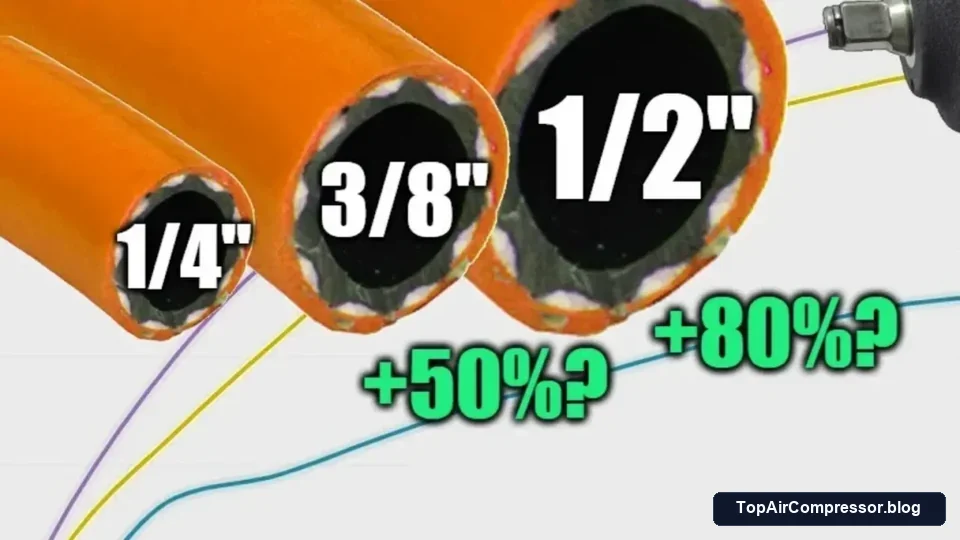
Friction against internal walls creates pressure drops over distance. Thinner conduits generate higher resistance, which starves demanding pneumatic machinery of the operating pressure needed for peak mechanical output.
Understanding these foundational principles prevents common mistakes in workshop design. Matching inner diameter to tool requirements ensures your compressor operates efficiently without unnecessary motor strain.
Air velocity through a hose is dictated by internal diameter, where a quarter-inch line restricts CFM delivery significantly faster than wider alternatives due to exponential friction losses along interior walls.
Laminar versus turbulent flow regimes dictate that doubling the internal diameter quadruples the volumetric capacity, fundamentally shifting how compressed air behaves under high velocity conditions in pneumatic circuits.
Boundary layer friction creates a stagnant air ring against the hose wall, reducing effective bore size and compounding pressure drops in narrower configurations during continuous high-demand tool operation.
- Internal cross-sectional area limits maximum CFM transfer capacity.
- Frictional resistance increases exponentially over longer hose lengths.
- Pressure drop directly impacts the working torque of pneumatic tools.
Frictional Resistance and Air Velocity
Compressed air traveling through narrow channels experiences elevated velocity and friction. This thermal energy loss reduces the effective pressure delivered at the working end of your line.
Wider lines allow air to travel at lower speeds with reduced friction. Lower resistance translates to stable working pressures during continuous high-demand workshop applications and assembly tasks.
- Narrow channels increase air velocity and thermal loss.
- Wider conduits maintain stable working pressures under load.
Peak Performance and Real-World Output Metrics
Measuring actual tool performance reveals stark differences between these two common diameters. A thin line struggles to feed high-consumption tools like grinders or heavy-duty impact wrenches.
When running continuous-draw equipment, thinner conduits cause noticeable tool lagging. The pressure starvation forces your compressor pump to cycle more frequently, increasing overall wear and energy consumption.
Upgrading to a wider conduit resolves most starvation issues instantly. You will notice immediate improvements in fastener depth consistency and rotational speed on high-torque air tools.
Delivering maximum pneumatic efficiency requires evaluating actual CFM output at the tool inlet rather than nominal tank pressure displayed on the primary regulator gauge during active deployment.
While smaller lines handle intermittent nailing tasks adequately, high-consumption grinders demand wider bores to prevent severe operational throttling and premature motor heat buildup under heavy industrial workloads.
Dynamic pressure loss curves prove that restrictive fittings and undersized couplings exacerbate output starvation, dropping effective working pressure below acceptable operational thresholds for demanding pneumatic impact wrenches.
- Thinner lines cause noticeable tool lagging under heavy loads.
- High-draw equipment requires wider internal diameters for efficiency.
- Proper sizing reduces excessive compressor pump cycling frequencies.
Evaluating CFM Delivery Under Heavy Loads
Cubic feet per minute delivery ratings drop significantly as hose length increases past twenty-five feet. Thinner tubing exacerbates this loss during intense multi-tool operations.
Maintaining adequate CFM requires matching your main line diameter to the maximum consumption rate of your most demanding workshop accessory or pneumatic paint sprayer.
- CFM ratings degrade rapidly over extended hose lengths.
- Matching line diameter prevents accessory starvation during painting.
Pressure Drop Calculations Across Standard Hose Lengths
Every foot of pneumatic tubing introduces measurable resistance to airflow. Engineers calculate this pressure drop to ensure tools receive adequate PSI at the business end.
A typical fifty-foot run of thin tubing can lose up to fifteen PSI under heavy load. This drop compromises the driving force of framing nailers and pneumatic ratchets.
Wider conduits typically limit this pressure loss to nominal levels over identical distances. Maintaining optimal working pressure guarantees predictable tool behavior across diverse job site environments.
Standard industrial engineering formulas calculate friction loss based on a standard fifty-foot span, where a quarter-inch hose often bleeds over fifteen PSI at standard ninety PSI operating levels.
Extending pneumatic lines beyond recommended limits amplifies frictional resistance, making a dependable air compressor hose reel essential for maintaining consistent torque output across mobile service truck compressor setups.
Pressure drop compounds non-linearly over distance, forcing technicians to step up internal diameters when routing air through large workshops to preserve pneumatic tool efficiency at remote workstations.
- Pneumatic resistance increases steadily with every foot of length.
- Thin lines experience severe PSI drops under heavy operational loads.
- Wider conduits minimize pressure loss across extended job runs.
Mitigating Pressure Loss on Extended Job Sites
Job sites often require reaching distant areas far from the stationary compressor unit. Using larger main lines up to the work zone minimizes overall pressure drop.
Connecting a short, flexible whip hose at the tool terminal preserves ergonomics without sacrificing the sustained airflow delivered by your primary supply line.
- Distant work zones demand careful consideration of line sizing.
- Whip hoses preserve tool maneuverability without sacrificing airflow.
Build Quality, Materials, Maintenance, and Durability
Pneumatic lines face harsh working environments involving rough concrete, sharp metal debris, and chemical exposure. Selecting durable outer jackets prevents premature cracking and dangerous ruptures.
Hybrid polymer, polyurethane, and reinforced rubber materials offer varying degrees of kink resistance. A robust wall thickness protects against crushing injuries from rolling tool carts and vehicles.
Routine inspection of fittings and outer walls prevents catastrophic failure under high pressure. Proper coil storage extends service life regardless of the chosen internal diameter size.
Modern pneumatic lines utilize hybrid polymer, polyurethane, or reinforced rubber blends, where polyurethane offers superior abrasion resistance while maintaining flexibility across extreme sub-zero weather operating environments.
Routine daily inspections must check for micro-cracks, fitting corrosion, and internal blistering that can cause catastrophic line failure and dangerous whipping hazards under high-pressure shop conditions.
Proper storage using wall-mounted reels prevents kinking and degradation from UV exposure, especially when paired with the best type of air compressor hose for heavy-duty industrial supply lines in professional settings.
- Harsh job sites demand resilient outer jackets and reinforcement.
- Robust wall thickness prevents crushing damage from heavy equipment.
- Routine inspections safeguard against sudden high-pressure line failures.
Kink Resistance and Outer Jacket Construction
Kinking restricts airflow instantly and damages internal reinforcement braids over time. Premium polymer compounds naturally resist memory curl and maintain smooth internal bores.
Thicker walls inherently provide superior structural integrity against sharp bends and external abrasion, ensuring long-term reliability in professional contractor environments.
- Kinking restricts airflow and degrades internal reinforcement layers.
- Premium polymers resist memory curl and maintain smooth bores.
Ergonomics, Weight, Flexibility, and Footprint
Physical fatigue becomes a major factor during all-day framing or trim carpentry tasks. Lighter pneumatic lines reduce wrist strain when maneuvering tools in awkward overhead positions.
Thinner conduits offer superior flexibility and coil easily into compact storage spaces. This enhanced maneuverability makes them favorite options for mobile technicians and finish carpenters.
Conversely, heavier supply lines require more effort to drag across rough terrain. However, their superior performance profile often outweighs the minor ergonomic penalty in heavy shops.
Operator fatigue correlates directly with line mass, making lightweight hybrid polymer hoses considerably easier to maneuver overhead during repetitive framing and automotive assembly line applications all day.
Cold weather stiffness plagues traditional rubber variants, whereas choosing the best air compressor hose for cold weather retains suppleness in freezing temperatures, improving overall workspace safety and reducing trip hazards.
Storage footprint matters in cramped mobile service vans, where compact coiling capabilities of smaller diameter lines optimize valuable cargo space without sacrificing essential reach around large vehicles.
- Lighter lines reduce wrist strain during overhead carpentry tasks.
- Thin conduits coil easily for convenient storage and transport.
- Heavy supply lines require greater effort to navigate across obstacles.
Storage Footprint and Workplace Mobility
Compact hose reels demand less space in service trucks and crowded workshops. Managing shorter, thinner runs takes seconds compared to wrestling bulky heavy-duty lines.
Balancing mobility requirements against airflow needs ensures your daily workflow remains efficient without causing unnecessary physical strain or tangled workspace hazards.
- Compact reels optimize storage space in service vehicles.
- Managing smaller lines minimizes setup and teardown times.
Tool Compatibility and Air Consumption Demands
Different pneumatic tools impose vastly different volumetric demands on your compressed air system. Low-draw devices operate flawlessly on restricted lines without stuttering or losing power.
High-demand machinery requires unrestricted pathways to maintain continuous operation cycles. Matching hose diameter to tool specifications prevents frustrating performance bottlenecks during critical project phases.
Consulting manufacturer recommendations regarding minimum line sizes protects your investment. Proper pairing ensures tools operate at peak efficiency throughout their expected service lifespan.
Matching hose diameter to tool air consumption prevents starvation, ensuring that high-CFM sanders and heavy-duty impact wrenches receive adequate volume for sustained torque delivery under load.
Brad nailers and staple guns require minimal volume, operating efficiently on restrictive lines, whereas rotary grinders demand unrestricted airflow to prevent stalling during aggressive metal fabrication tasks.
Reviewing manufacturer CFM requirements at ninety PSI helps technicians select appropriate feeder lines, balancing tool performance requirements against acceptable weight and maneuverability trade-offs in professional environments.
- Low-draw devices operate well on restricted pneumatic lines.
- High-demand machinery requires unrestricted airflow pathways.
- Manufacturer guidelines protect tool investments from pressure starvation.
Matching Diameter to Specific Workshop Machinery
Brad nailers and staplers consume minimal air volume per cycle, making restricted lines entirely sufficient. Impact wrenches and sanders demand heavy volume to sustain operation.
Assessing your primary tool inventory guides optimal setup decisions, preventing the purchase of undersized lines that restrict high-performance workshop accessories.
- Brad nailers consume minimal air per operating cycle.
- Sanders and impacts require heavy volume for sustained runs.
Decision Framework for Professional and DIY Workloads
Choosing the ideal pneumatic line depends entirely on your specific project frequency and tool inventory. Casual weekend DIYers rarely need heavy industrial conduit for basic inflation tasks.
Professional contractors benefit from investing in robust, high-volume lines that accommodate diverse machinery. A strategic purchasing approach maximizes efficiency and prevents costly equipment upgrades later.
Analyze your typical working distance from the compressor tank before purchasing. Proper planning guarantees seamless pneumatic operation across every job site application you encounter.
Selecting the ideal pneumatic line involves balancing portability against maximum CFM delivery, ensuring your compressor setup meets the demands of both hobbyist garages and busy commercial repair shops.
DIY users tackling basic inflation and trim carpentry benefit from lightweight maneuverability, while professional mechanics require high-flow plumbing to run demanding air ratchets and pneumatic cut-off tools continuously.
Analyzing your primary tool roster dictates the optimal investment strategy, preventing premature equipment upgrades by future-proofing your compressed air distribution network against expanding operational capacity needs.
- DIY users excel with lightweight, portable pneumatic lines.
- Contractors require durable, high-volume industrial conduits.
- Analyzing working distances prevents costly accessory mistakes.
Summary Guidelines for Optimal Setup Selection
Prioritize portability and ease of handling for light trim and finish work. Select larger diameters when operating high-torque impact tools or running long distances.
Evaluating these core mechanical trade-offs ensures your compressed air infrastructure delivers reliable, maintenance-free performance across all professional and residential job applications.
- Prioritize portability for finish carpentry and trim work.
- Select larger diameters for high-torque impact operations.
Frequently Asked Questions
Can I use quick couplers with both hose sizes?
Yes, standard industrial quick couplers fit both diameters seamlessly. Proper fitting selection ensures zero air leaks at connection points.
Does a wider hose increase my compressor tank pressure?
No, hose diameter does not alter tank pressure ratings. Wider lines simply reduce frictional resistance and delivery pressure drops.
Is a heavier hose harder to coil in cold weather?
Yes, traditional rubber lines stiffen significantly in freezing temperatures. Hybrid polymer materials maintain flexibility across extreme thermal gradients.
Will a larger hose ruin my small brad nailer?
No, tools only consume the air volume they require. Larger lines simply ensure the tool receives adequate pressure under load.
What is the maximum recommended length for portable setups?
Fifty feet is the standard threshold before pressure drop becomes noticeable. Using wider diameters helps extend this effective working distance safely.