Air Compressor Single vs. Two Stage: Which Fits Your Setup Better?
Choosing the right pneumatic setup requires balancing pressure demands with operational duty cycles. Evaluating single versus two stage pumps prevents costly equipment mismatches in professional fabrication environments.


Single-stage units excel in intermittent residential garages, whereas two-stage compressors dominate heavy industrial fabrication shops requiring sustained high-pressure pneumatic delivery.
Compare all top models in our Best Air Compressor: Top Picks for Every Garage & Roadside.
Side-by-Side Breakdown
| Criteria | Air Compressor Single | Two Stage | Edge |
|---|---|---|---|
| Peak Performance & Output | Up to 135 PSI continuous | Up to 175 PSI continuous | Two Stage |
| Duty Cycle & Consistency | 50% to 65% duty cycle | 80% to 100% duty cycle | Two Stage |
| Operating Noise & Vibration | Moderate mechanical vibration | Balanced dual-cylinder damping | Two Stage |
| Portability & Footprint | Compact vertical designs | Heavy stationary footprint | Air Compressor Single |
| Maintenance & Service Life | Simplified consumer servicing | Industrial cast-iron durability | Two Stage |
| Power Requirements | Standard 115V or 230V | Dedicated 230V or three-phase | Air Compressor Single |
| Best Ideal Use-Case | Automotive repair & nailing | Commercial body shops & manufacturing | Two Stage |
Engineering Fundamentals and Technical Aspects
Single-stage air compressors utilize one piston stroke to compress atmospheric air directly into the storage tank. This mechanism provides adequate pressure for general automotive tools and standard pneumatic nail guns.
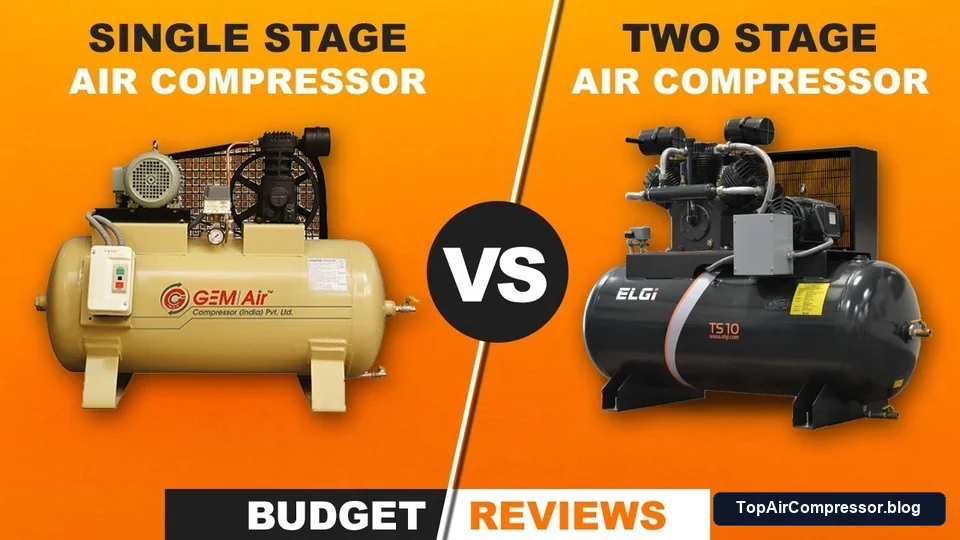
Two-stage systems incorporate an additional intercooler loop between pistons. The first cylinder compresses ambient air, which then passes through cooling tubes before entering a smaller high-pressure secondary cylinder.
Standard single-stage compressors utilize one piston stroke to compress air directly, typically maxing out near 135 PSI within our best 60 gallon single stage air compressor rankings for busy automotive garages.
Conversely, two-stage systems route air through an intercooler tube between cylinders, dropping the temperature before a smaller piston elevates the pressure up to 175 PSI or higher for industrial pneumatic tools.
- Single piston direct compression cycle
- Dual stage intercooler thermal reduction
- Direct tank pressure delivery mechanics
Piston Displacement and Compression Ratios
Understanding volumetric efficiency requires examining how cylinder displacement dictates compressed air output. Higher compression ratios in industrial pumps reduce wasted mechanical energy during heavy workloads.
Single-stage pumps work well for lower pressure thresholds. Heavy manufacturing applications demand multi-stage compression to maintain steady CFM delivery without overheating.
- Cylinder displacement metrics
- Volumetric efficiency ratios
Evaluating the Operational Benefits and Drawbacks of Each Compressor Type
Evaluating mechanical trade-offs highlights operational boundaries across popular units, with our best single stage air compressor recommendations offering lower initial acquisition costs and simpler maintenance routines for weekend mechanics.
Conversely, two-stage configurations deliver superior volumetric efficiency at higher operating pressures. Their primary drawback involves heavier electrical infrastructure requirements and significantly higher initial equipment investments.
Single-stage units offer lower initial costs and simpler mechanical designs, making them ideal for intermittent shop tasks, though their high duty cycles often cause excessive heat buildup and rapid valve wear.
Two-stage configurations deliver superior volumetric efficiency and continuous pressure delivery, yet they demand heavier foundations to absorb vibration harmonics and require more complex maintenance schedules for proper check valves.
- Lower entry cost for single stage units
- High pressure consistency for industrial operations
- Increased electrical demands for heavy machinery
Operational Trade-offs in Shop Environments
Weighing capital expenditure against daily productivity helps facilities select optimal equipment. Smaller shops benefit from the simplicity of single-stage units.
Industrial operations require the rugged reliability and higher duty cycles found only in multi-stage reciprocating compressors.
- Capital expenditure versus productivity
- Duty cycle limitations
Digital Shop Management and Technical Integration
Modern fabrication facilities often integrate pneumatic infrastructure with advanced digital monitoring systems. Connecting compressors to enterprise shop networks mirrors how educational platforms utilize LMS integration with Microsoft Classroom Education Tenant architectures.
Tracking runtime hours and pressure drops digitally optimizes maintenance schedules across large fleets. Aligning hardware diagnostics with software dashboards ensures seamless operational continuity in heavy manufacturing environments.
Modern facilities integrate programmable logic controllers to monitor tank pressure transducers, automatically adjusting compressor run times to match real-time pneumatic demands across automated assembly lines and robotic work cells.
Implementing smart IoT vibration sensors helps technicians predict impending bearing failures while exploring our best two-stage air compressor guide for heavy-duty industrial pneumatic installations.
- Digital runtime tracking systems
- Enterprise network connectivity protocols
- Automated preventive maintenance alerts
Smart Diagnostics in Pneumatic Networks
Advanced IoT sensors monitor compressor temperature and vibration levels in real time. Catching minor mechanical anomalies early prevents catastrophic pump failures on busy production lines.
Integrating diagnostic software streamlines facility management and reduces unexpected equipment downtime significantly.
- IoT sensor deployment
- Real-time vibration monitoring
Power Requirements and Electrical Infrastructure
Electrical demands dictate where you can safely install each compressor type. Standard single-stage units typically operate on common 115V or 230V residential circuits without requiring dedicated heavy-duty wiring.
Heavy-duty two-stage machinery demands robust three-phase electrical service to handle high starting torque and continuous running loads. Facility managers must consult licensed electricians before installing industrial-grade pneumatic equipment.
Electrical demands scale significantly when transitioning from single-stage to two-stage pumps, frequently requiring three-phase power upgrades and heavy-gauge copper wiring to safely handle higher starting amperage spikes.
Facility engineers must calculate exact motor load amperages alongside magnetic starter ratings, ensuring compliance with local electrical codes while preventing thermal overloads during prolonged continuous-duty cycles.
- Residential 115V and 230V compatibility
- Industrial three-phase power necessities
- High starting torque management
Circuit Breakers and Voltage Drops
Inadequate wiring causes voltage drops that can permanently damage electric motors. Ensuring proper breaker sizing protects your compressor investment from electrical overloads.
Industrial installations require dedicated lines to prevent interference with sensitive shop equipment.
- Proper breaker sizing rules
- Voltage drop prevention
Thermal Dynamics and Cooling Efficiency
Heat generation remains a primary limiting factor in pneumatic compression longevity. Single-stage pumps run hotter because air is compressed to its final PSI in one continuous stroke.
Premium units featured in our best two-stage air compressor for the money roundup utilize intercoolers to dissipate thermal energy, drastically lowering discharge temperatures and protecting downstream air hoses.
Managing heat rejection is critical because compressed air naturally increases in temperature, necessitating efficient cast-iron aftercoolers to drop moisture levels before the air enters the main storage vessel.
Two-stage designs naturally excel in thermal management by utilizing finned intercoolers, which dissipate heat between compression stages and protect internal reed valves from thermal degradation and carbon buildup.
- Single stroke heat accumulation
- Intercooler thermal dissipation systems
- Lower downstream air temperatures
Thermal Management in Continuous Duty Pumps
Managing operating temperatures extends pump valve and piston ring lifespan. Effective airflow design around cylinder heads prevents thermal fatigue during peak summer months.
Industrial shops often add auxiliary cooling fans to maintain safe operating temperatures.
- Valve lifespan protection
- Auxiliary cooling fan placement
Maintenance Protocols and Service Life
Routine maintenance extends the service life of any reciprocating piston air compressor. Operators must check oil levels weekly, drain moisture tanks daily, and replace inlet air filters regularly.
Two-stage industrial pumps generally feature cast-iron crankcases designed for tens of thousands of operating hours. Their rebuildable components offer a significantly longer lifecycle than lighter consumer-grade single-stage alternatives.
Routine maintenance schedules dictate checking oil levels daily, replacing synthetic lubricants every two thousand hours, and inspecting intake filter elements weekly to prevent premature cylinder wall scoring in reciprocating pumps.
Two-stage compressors often achieve extended service lives exceeding twenty years when maintained properly, largely due to lower operating temperatures and reduced mechanical stress distributed across dual compression chambers.
- Daily moisture tank draining procedures
- Weekly oil level verification checks
- Cast-iron pump durability standards
Rebuild Intervals and Component Wear
Quality industrial compressors feature replaceable cylinder sleeves and heavy-duty bearings. Routine overhauls restore factory performance without requiring complete unit replacement.
Consumer models often use non-serviceable components designed for shorter operational lifespans.
- Replaceable cylinder sleeves
- Bearing overhaul procedures
Reference Materials and Further Reading
Expanding your technical knowledge requires consulting authoritative engineering manuals and industry standards. Reviewing manufacturer technical bulletins ensures compliance with OSHA safety regulations and optimal pneumatic performance.
Additional resources include specialized trade publications, thermodynamic textbooks, and comprehensive equipment operator guides. Utilizing these educational materials helps technicians master complex compressed air system designs.
Facility managers should consult OSHA safety standards regarding pressure vessel certifications, alongside manufacturer technical manuals covering proper torque specifications for head bolts and intercooler fittings during overhauls.
Reviewing compressed air CAGI data sheets provides standardized performance metrics, allowing engineers to verify volumetric output claims against actual power consumption before finalizing major equipment capital expenditure budgets.
- OSHA pneumatic safety standards compliance
- Manufacturer engineering technical bulletins
- Thermodynamic design reference textbooks
Industry Publications and Standards
Staying updated on ASME codes ensures your compressed air storage tanks meet legal safety requirements. Professional associations publish valuable guidelines regarding pressure vessel inspections.
Continuous education keeps maintenance technicians certified for complex industrial installations.
- ASME pressure vessel codes
- Technician certification programs
Frequently Asked Questions
What is the main difference between single and two-stage compressors?
Single-stage compressors use a single piston stroke to reach target working pressures, whereas robust two-stage units compress ambient air twice through an advanced intercooler loop.
This clever secondary stage allows heavy industrial models to generate much higher continuous PSI outputs far more efficiently for demanding commercial applications.
Can a single-stage compressor run a sandblaster?
Most standard single-stage air compressors struggle to maintain the continuous high CFM required for effective abrasive sandblasting operations. Two-stage systems are strongly recommended because they deliver the sustained high-pressure airflow needed to prevent frustrating pressure drops during extended blasting tasks.
Why do two-stage compressors require special electrical wiring?
Industrial two-stage compressors feature larger heavy-duty electric motors that draw significantly more startup amperage than standard residential units. Facilities must install dedicated high-voltage circuits or three-phase power drops to safely handle the heavy electrical load without tripping breakers.
How often should compressor oil be changed?
Oil-lubricated reciprocating compressors typically require a complete oil change after the first one hundred initial break-in operating hours. Subsequent oil changes should occur every three to six months depending on shop humidity and daily runtime intensity.
Do two-stage compressors last longer than single-stage models?
Heavy-duty two-stage compressors generally feature durable cast-iron pumps and rebuildable components designed for extensive commercial lifespans. Proper preventive maintenance allows these industrial machines to operate reliably for decades under demanding daily workloads.