Air Impact Wrench vs. Cordless: Which Setup Fits Your Workflow?
Choosing between pneumatic power and lithium-ion battery technology defines your shop efficiency. We analyze raw torque delivery, sustained duty cycles, and everyday ergonomics.

For continuous high-torque industrial work, the air impact wrench remains undefeated. For mobile service and general shop versatility, a modern cordless impact delivers exceptional convenience.
Compare all top models in our Best Air Compressor: Top Picks for Every Garage & Roadside.
Side-by-Side Breakdown
| Criteria | Air Impact Wrench | Cordless | Edge |
|---|---|---|---|
| Peak Performance & Output | Higher sustained torque-to-weight ratio | High initial torque, drops under load | Air Impact Wrench |
| Duty Cycle & Consistency | 100 percent continuous duty cycle | Limited by battery thermal throttling | Air Impact Wrench |
| Operating Noise & Vibration | High exhaust noise, low motor vibration | Quiet motor, high mechanical vibration | Cordless |
| Portability & Footprint | Tethered to heavy air hoses | Completely autonomous and highly portable | Cordless |
| Maintenance & Service Life | Minimal motor wear, needs oiling | Complex electronics, battery degradation | Air Impact Wrench |
| Power Requirements | Requires robust stationary compressor | Requires charged lithium-ion battery packs | Cordless |
| Best Ideal Use-Case | Heavy assembly lines and busy shops | Mobile roadside repairs and framing | Tie (Application Dependent) |
Torque Delivery and Raw Pneumatic Power
Pneumatic impact wrenches leverage continuous compressed air flow to generate massive rotational force. This mechanical advantage provides superior torque consistency during demanding industrial operations without suffering from thermal overload limits.
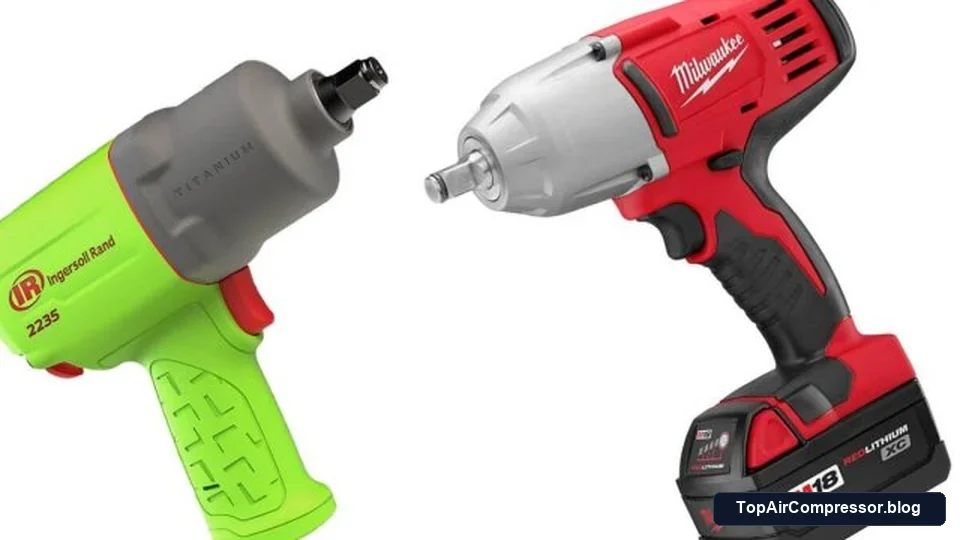
Unlike electric alternatives, air motors maintain maximum output until your compressor loses pressure. This reliable delivery prevents fastener rounding and ensures predictable fastener breakaway performance across stubborn rusted truck lug nuts.
Operating an air tool requires a reliable CFM supply from your compressor manifold. Undersized air lines or restrictive fittings will severely choke your tool performance and reduce overall operational efficiency significantly.
Pneumatic wrenches leverage continuous compressed air flow through rotary vanes, delivering sustained high-torque outputs without internal thermal degradation under heavy industrial fastening and unbolting workloads.
Air consumption rates often exceed 6 to 8 CFM at 90 PSI, requiring appropriately sized shop compressors to prevent pressure drops during prolonged heavy-duty assembly operations.
Twin-hammer impact mechanisms inside pneumatic housings convert raw motor rotation into rapid, high-frequency strikes, maximizing breakaway torque across rusted automotive lug nuts and structural bolts.
- Pneumatic motors offer unmatched power-to-weight ratios.
- Continuous airflow prevents dangerous thermal shutdown events.
- Consistent torque prevents stripped automotive wheel fasteners.
Understanding CFM Demands Under Heavy Loads
Pairing your setup with units from our best air compressor for impact wrench guide ensures sufficient pressure delivery and eliminates unwanted workflow interruptions during heavy shop tasks.
Always verify that your compressor delivers adequate cubic feet per minute at ninety pounds per square inch. Proper supply guarantees uninterrupted fastener removal during high-volume automotive service applications.
- Check compressor CFM ratings before purchasing high-draw pneumatic wrenches.
- Use half-inch inner diameter hoses to prevent pressure loss.
Battery Chemistry and Cordless Evolution
Modern lithium-ion battery technology has revolutionized portable fastening tools significantly. High-capacity battery packs now deliver impressive breakaway torque that easily rivals traditional entry-level pneumatic shop equipment.
Brushless electric motors maximize energy transfer from the battery pack while minimizing internal friction. This advanced engineering extends your operational runtime and reduces internal heat buildup during repetitive fastening tasks.
However, heavy continuous use forces battery management systems to throttle output. Thermal protection safeguards internal cells but creates noticeable performance lulls during extended heavy-duty industrial assembly work.
Modern cordless impact wrenches rely on advanced lithium-ion cells engineered to discharge high current draws safely without experiencing catastrophic voltage sag during demanding fastener applications.
High-output battery packs incorporate intelligent thermal management circuits that monitor cell temperatures, protecting internal chemistries from overheating during continuous high-torque industrial fastening cycles.
Brushless direct-current motors eliminate physical commutator friction, increasing overall operational efficiency and extending battery runtime by up to fifty percent compared to older brushed designs.
- Lithium-ion cells provide remarkable mobile operational freedom.
- Brushless motors increase energy efficiency and tool longevity.
- Thermal throttling protects cells during extreme load phases.
Managing Battery Heat and Voltage Sag
High electrical draw causes temporary voltage sag under extreme mechanical loads. This electrochemical limitation reduces impact frequency and slows down fastener rundown speeds on stubborn bolts.
Operators must keep spare charged battery packs readily available near the workstation. Maintaining a rotating battery supply prevents costly downtime during critical commercial repair procedures.
- Voltage sag temporarily reduces impact frequency under heavy loads.
- Keep spare batteries charging to ensure continuous workflow.
Ergonomics, Weight Distribution, and Fatigue
Tool weight heavily influences technician fatigue throughout a demanding eight-hour shift. Pneumatic impact wrenches are exceptionally lightweight because they lack heavy internal motors and onboard battery packs.
Upgrading to flexible options from our best air hose for impact wrench selections reduces constant wrist strain and significantly improves spatial maneuverability inside cramped engine bays.
Balancing tool balance directly impacts wrist health and repetitive strain injuries. Choosing the right form factor prevents long-term joint damage during intensive production line assembly operations.
Pneumatic impact tools typically feature lighter composite housings because they lack onboard battery weight, reducing wrist strain during overhead automotive repairs and assembly line work.
Cordless models concentrate significant weight at the base of the handle, shifting the center of gravity downward and altering forearm muscle engagement during extended use.
Hose drag from heavy-duty rubber lines introduces an external pulling force on pneumatic tools, requiring operators to compensate continuously to maintain proper tool alignment.
- Air tools feature lighter bodies due to missing battery packs.
- Air hoses introduce drag and restrict tight angle access.
- Cordless models offer superior mobility in cramped engine bays.
Hose Drag Versus Battery Bulk Trade-Offs
Heavy rubber hoses catch on vehicle frames and tool carts constantly. Technicians must actively manage hose routing to prevent frustrating snags during fast-paced automotive service operations.
Conversely, heavy battery packs shift the center of gravity downward toward the grip. This added weight demands greater forearm strength to maintain stable tool alignment over long work shifts.
- Rubber hoses frequently catch on vehicle lift arms.
- Heavy battery packs increase forearm fatigue over long shifts.
Duty Cycles and Thermal Management Limits
Industrial production environments demand equipment capable of running continuously without interruption. Pneumatic tools boast virtually infinite duty cycles because compressed air naturally cools the motor during operation.
Electric motors generate substantial internal heat when subjected to continuous high-torque demands. Without adequate cooling intervals, thermal limits trigger automatic safety shutdowns that halt production workflows entirely.
Shops running multiple shifts rely on air systems to eliminate battery rotation delays. This continuous operational capability makes pneumatic setups indispensable for heavy commercial manufacturing facilities.
Selecting tools from our best air impact wrench for small compressor guide guarantees virtually unlimited duty cycles because expanding compressed air naturally cools the mechanical motor housing during continuous industrial shifts.
Cordless tools face strict thermal limits dictated by battery heat dissipation, forcing automatic tool shutdowns when internal cell temperatures exceed safe operational thresholds.
Heavy continuous fastening with battery-powered units rapidly accelerates internal component wear, demanding mandatory cooling intervals between high-torque applications to prevent permanent motor damage.
- Pneumatic tools feature unlimited duty cycles under heavy loads.
- Electric motors require cooling periods to prevent thermal damage.
- Compressed air expands and naturally cools internal motor components.
Sustained Output in High-Volume Assembly
Assembly line technicians cannot afford unexpected equipment thermal shutdowns. Pneumatic wrenches deliver consistent power output hour after hour without experiencing motor degradation or power loss.
Electric alternatives require careful monitoring of internal temperatures during aggressive bolting sequences. Overlooking these limits causes premature component failure in expensive professional-grade cordless tools.
- Assembly lines require zero downtime for thermal recovery.
- Monitor tool heat to prevent expensive internal electrical failures.
Operating Environment and Jobsite Mobility
Mobile service technicians working away from stationary shops require complete equipment independence. Cordless impact wrenches eliminate bulky air compressors and supply hoses, providing ultimate field portability for remote roadside repairs.
Stationary automotive repair shops benefit immensely from permanent hard-piped air systems. Plumbed air lines supply reliable pneumatic power directly to every workstation without worrying about dead batteries or charging stations.
Harsh industrial environments containing moisture or flammable vapors present unique challenges. Pneumatically powered tools offer inherent safety advantages because they produce no electrical sparks near hazardous materials.
Cordless impact wrenches offer unmatched jobsite mobility, eliminating cumbersome air hoses and allowing technicians to work freely in remote or elevated locations without power constraints.
Pneumatic tools thrive in hazardous or wet environments where electrical sparks pose explosion risks, relying purely on inert compressed air for safe mechanical operation.
Extreme cold weather severely impacts battery chemical reactions, drastically reducing cordless runtime, whereas pneumatic tools operate reliably provided airlines are cleared of moisture buildup.
- Cordless tools eliminate the need for heavy tow compressors.
- Stationary shops rely on hard-piped manifold air networks.
- Pneumatic tools contain no electrical switches to spark vapors.
Remote Service Work Versus Fixed Bays
Roadside assistance technicians rely entirely on battery-powered equipment for quick deployment. Carrying portable generators and gas compressors is impractical for rapid mobile response service trucks.
Fixed service bays thrive on centralized screw compressors feeding multiple overhead hose reels. This centralized infrastructure provides limitless compressed air for every technician simultaneously.
- Mobile service trucks require independent battery-powered tools.
- Fixed bays utilize centralized plumbing and overhead reels.
Maintenance Protocols and Long-Term Durability
Equipment longevity depends heavily on consistent preventive maintenance routines and proper care. Air impact wrenches feature simple mechanical designs with few moving parts, ensuring exceptional service life when lubricated daily.
Pneumatic tools require regular oiling through inline lubricators to prevent internal corrosion. Neglecting moisture in compressed air lines causes rapid vane deterioration and catastrophic motor failure within months.
Cordless tools contain complex printed circuit boards and sensitive brushless stators. While mechanical gearboxes last for years, chemical battery degradation eventually requires expensive pack replacements over time.
Pneumatic wrenches demand daily lubrication via inline oilers to protect internal steel components from friction wear and moisture-induced corrosion over years of heavy use.
Cordless impact wrenches require minimal mechanical maintenance but demand careful inspection of battery terminal contacts to prevent electrical resistance and power transfer failures.
Long-term durability favors well-maintained pneumatic systems, which lack degradation-prone electronic circuit boards and chemical batteries that typically degrade within three to five years of service.
- Air tools feature simple mechanical designs with high durability.
- Daily pneumatic oiling prevents internal moisture corrosion damage.
- Battery packs degrade chemically and require periodic replacement.
Moisture Mitigation in Pneumatic Lines
Water condensation inside compressed air lines destroys pneumatic motor components quickly. Installing refrigerated air dryers and water separators protects your valuable investment from premature rust and wear.
Choosing equipment featured in our best air compressor to run impact wrench review helps maintain clean, dry air and ensures maximum mechanical reliability across your entire shop network.
- Water separators protect internal pneumatic motor components.
- Drain stationary compressor tanks daily to remove condensation.
Frequently Asked Questions
Can a cordless impact wrench truly replace an air impact wrench?
High-end cordless tools match pneumatic breakaway torque for short bursts. However, for continuous heavy industrial assembly, an air impact wrench remains superior due to limitless duty cycles.
Why do pneumatic impact wrenches weigh significantly less than cordless models?
Air tools rely on simple external compressors for kinetic energy generation. Consequently, they lack heavy internal electric motors and dense lithium-ion battery packs, creating a superior weight advantage.
How does cold weather affect cordless impact wrenches compared to air tools?
Sub-freezing temperatures drastically reduce lithium-ion battery capacity and chemical efficiency. Conversely, pneumatic tools operate reliably in cold conditions provided your compressed air system is free of frozen condensation.
What maintenance is required to keep an air impact wrench running smoothly?
Operators must inject pneumatic tool oil into the air inlet before every shift. This simple habit prevents internal rust and protects working vanes from premature mechanical wear over years of service.
Is the investment in a stationary air compressor worth it for a home garage?
Fixed compressors require dedicated electrical wiring and floor space in your garage. For occasional DIY automotive work, a high-output cordless impact provides better convenience without permanent plumbing setup.