Battery Impact Wrench vs. Air: Which Fits Your Setup Better?
Choosing between cordless convenience and pneumatic power dictates shop efficiency. We analyze torque delivery, runtime limits, and infrastructure demands.

Choose battery impact wrenches for mobile service trucks and rapid field repairs. Select pneumatic air tools for relentless heavy-duty assembly lines and continuous high-torque extraction.
Compare all top models in our Best Air Compressor: Top Picks for Every Garage & Roadside.
Side-by-Side Breakdown
| Criteria | Battery Impact Wrench | Air | Edge |
|---|---|---|---|
| Peak Performance & Output | High initial torque | Sustained uniform power | Air |
| Duty Cycle & Consistency | Voltage sag under load | Endless continuous cycle | Air |
| Operating Noise & Vibration | Moderate motor hum | High exhaust noise | Battery Impact Wrench |
| Portability & Footprint | Completely self-contained | Tethered to compressor | Battery Impact Wrench |
| Maintenance & Service Life | Battery pack aging | Decades with daily oil | Air |
| Power Requirements | Rechargeable lithium cells | Stationary electric compressor | Battery Impact Wrench |
| Best Ideal Use-Case | Mobile roadside service | High-volume auto shops | Split |
Fundamental Engineering Mechanics and Torque Delivery
Modern cordless impact wrenches rely on high-capacity lithium-ion cells and brushless DC motors. These electronic systems rapidly cycle internal hammers to deliver instantaneous rotational force against stubborn fasteners.
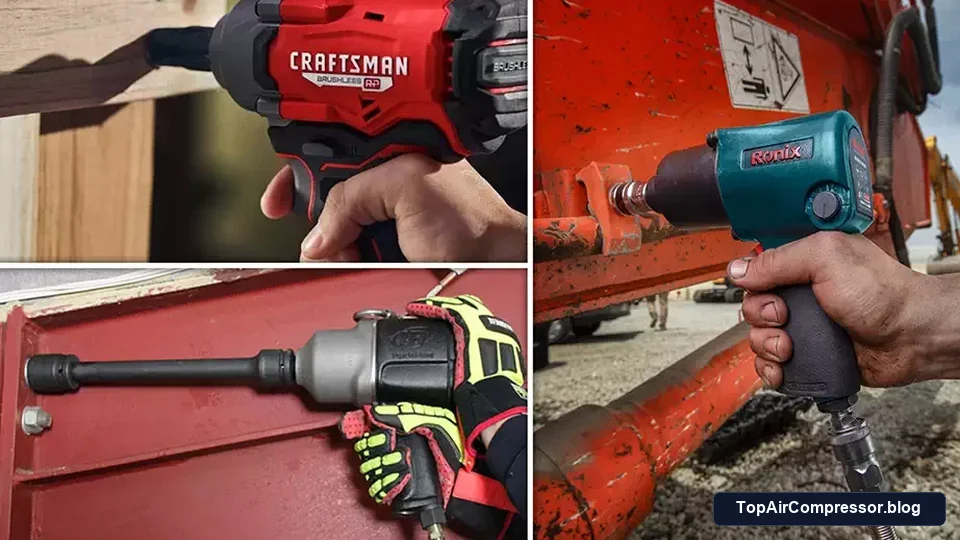
Pneumatic impact tools utilize compressed air expanding through a robust vane motor paired with our best air compressor for impact wrench setups. This steady fluid power drives a specialized twin-hammer mechanism designed for continuous heavy-duty industrial applications.
Pneumatic impacts convert compressed air flow via a sliding-vane motor into rapid rotational hammer strikes. This mechanical approach delivers instantaneous peak torque without electronic throttling constraints or thermal degradation risks during heavy fasteners.
Cordless models rely on brushless DC motors paired with heavy-duty gearboxes and high-discharge lithium-ion battery packs. Pulse-width modulation controls electrical current, providing precise output tuning but introducing potential voltage sag under extreme loads.
- Brushless motors maximize battery efficiency during heavy fastening.
- Fluid-driven vane motors provide continuous mechanical rotation.
- Hammer mechanisms translate rotational force into rapid impacts.
Internal Motor Dynamics
Electric switches regulate current flow instantly inside modern brushless battery housings. Pneumatic motors rely entirely on continuous volume flow rate from stationary air compressor storage tanks.
- Electronic control boards regulate battery discharge rates.
- Air volume dictates pneumatic motor rotational speed.
Evaluating Real-World Output and Fastening Consistency
Pneumatic systems maintain maximum rated torque continuously throughout long shifts without performance degradation. Using the best air impact wrench for small compressor setups ensures uniform fastening power across thousands of bolts.
Cordless units deliver exceptional initial breakaway torque but experience voltage sag under prolonged heavy loads. As battery packs discharge during intensive service intervals, peak impact force gradually diminishes.
Air tools maintain consistent power delivery as long as your compressor supplies adequate CFM at ninety PSI. Pneumatic pressure stability ensures identical breakaway force across hundreds of continuous production line cycles without fading.
Battery impacts output maximum force on fully charged cells, yet torque drops progressively as state-of-charge depletes. Smart battery management systems mitigate this, but long sessions require frequent pack swaps to maintain uniform tightening specs.
- Air tools offer unwavering torque output under continuous load.
- Battery packs experience voltage drop during extended usage.
- Consistent pressure prevents uneven bolt tensioning in shops.
Handling Stubborn Fasteners
Rusted truck lug nuts require immense initial breakaway force from any impact tool. Air tools deliver relentless hammer blows without thermal throttling concerns during difficult extraction jobs.
- Breakaway torque dictates fastener removal success.
- Thermal buildup can trigger battery protection modes.
Infrastructure Demands and Shop Footprint Realities
Setting up an air compressor network requires dedicated shop space and permanent electrical wiring. Choosing the best air compressor to run impact wrench tasks guarantees limitless fluid power capacity for your facility.
Battery platforms eliminate complex shop infrastructure by packing their energy source directly onboard. Technicians can deploy high-torque fastening tools instantly across remote job sites without trailing hoses.
Pneumatic systems require stationary infrastructure including fixed iron piping, refrigerated air dryers, and a dedicated rotary screw compressor. Proper filtration plumbing prevents moisture damage, restricting mobility strictly to the length of your hose reels.
Cordless setups eliminate tethered lines entirely, trading stationary plumbing for multi-bay charging stations and battery management rotations. Grid power availability replaces compressed air CFM calculations, offering ultimate jobsite versatility and rapid deployment capabilities.
- Compressors demand permanent floor space and dedicated circuits.
- Cordless tools offer instant deployment on any job site.
- Rigid piping ensures reliable air delivery across large facilities.
Mobility Versus Stationary Power
Field service trucks require self-contained power solutions like heavy-duty battery arrays. Stationary manufacturing facilities benefit from centralized screw compressors feeding multiple drop lines simultaneously.
- Service trucks rely on portable cordless ecosystems.
- Shops utilize centralized compressed air distribution.
Ergonomics, Tool Weight, and Operator Fatigue Factors
Removing heavy air hoses drastically reduces wrist fatigue and improves maneuverability in tight engine bays. Cordless tool ergonomics prioritize balanced weight distribution despite the inclusion of heavy battery packs.
Pneumatic wrenches boast extremely lightweight housings because they lack heavy onboard power cells. However, stiff rubber supply lines create persistent drag and awkward handling during overhead automotive repairs.
Air impacts boast exceptionally lightweight composite housings because they house no heavy onboard motors or energy cells. Reduced tool mass significantly decreases wrist strain during overhead automotive repairs or extended assembly line operations.
Battery-powered alternatives concentrate heavy lithium-ion blocks at the base, altering balance points and increasing overall tool gravity. Center of gravity shifts require stronger grip force, potentially accelerating forearm fatigue during high-volume bolting tasks.
- Air hoses create physical drag during extended operations.
- Battery packs add significant weight to cordless handles.
- Balanced housings reduce operator strain in tight spaces.
Managing Tool Balance
Engineers carefully position battery slots to balance the heavy motor weight. Pneumatic housings remain compact and light since motive power originates miles away at the compressor.
- Battery placement affects overall wrist comfort.
- Lightweight pneumatic bodies minimize arm fatigue.
Maintenance Protocols and Long-Term Equipment Durability
Air-powered wrenches feature simple mechanical designs with very few electronic components to fail. Pairing them with the best air hose for impact wrench setups ensures decades of reliable, heavy-duty industrial service life.
Battery impact models face eventual obsolescence when proprietary lithium-ion battery packs degrade chemically over time. Electronic control boards also remain vulnerable to moisture and heavy drop impacts.
Pneumatic wrenches demand daily oil lubrication via inline mist lubricators to protect internal steel air motors from seizing. Routine moisture draining from storage tanks prevents internal corrosion and extends service intervals across heavy industrial shifts.
Cordless tools eliminate airline maintenance entirely, shifting upkeep focus to terminal cleaning and cooling vent clearing. Lithium-ion cell degradation remains the primary lifespan bottleneck, requiring pack replacements every few years under heavy commercial usage.
- Pneumatic tools require daily lubrication for longevity.
- Battery packs eventually lose charge capacity over years.
- Electronic components risk damage from jobsite moisture.
Service Life Expectations
Industrial air tools frequently operate for decades with routine seal replacements. Cordless impact wrenches typically require battery replacements every few years under heavy professional daily use.
- Air motors outlast electronic battery management systems.
- Consumable battery packs increase long-term operating costs.
Thermal Management and Continuous Duty Cycle Limits
Continuous fastening tasks generate extreme heat within both cordless motor windings and pneumatic vane assemblies. Thermal overload protection circuits in battery tools will automatically shut down tools during abuse.
Air tools tolerate stalling and severe thermal stress much better than sensitive electronic circuit boards. Pneumatic systems simply exhaust expanding air, keeping the tool running cool during high-cycle production.
Air motors operate exceptionally cool because expanding compressed air naturally absorbs heat during mechanical energy conversion processes. Thermal dissipation efficiency allows pneumatic tools to run continuously in high-temperature environments without experiencing performance throttling.
Heavy electrical draw generates substantial internal heat within cordless motor windings and onboard computer control boards. Overheat protection circuits automatically shut down the tool during aggressive bolting tasks to prevent permanent stator damage.
- Battery tools feature thermal cutoffs to prevent motor burnout.
- Expanding compressed air naturally cools pneumatic impact motors.
- High duty cycles favor air tools in assembly lines.
Preventing Motor Overheating
Intensive commercial assembly work pushes electric motors past safe thermal limits rapidly. Pneumatic motors handle continuous stalling without damaging delicate internal semiconductor microchips.
- Semiconductors require careful thermal management protection.
- Pneumatic exhaust air dissipates operating heat instantly.
Matching Tool Technology to Your Specific Workload
Professional tire shops and assembly lines demand the unwavering consistency of a robust pneumatic air setup. High duty cycles and zero downtime requirements heavily favor permanent compressed air networks.
Mobile service technicians, roadside mechanics, and general contractors benefit immensely from cordless freedom. Battery-powered impact wrenches eliminate cumbersome generators and hoses while delivering impressive field performance.
Stationary automotive assembly bays and tire service shops benefit immensely from permanent pneumatic piping networks and unlimited duty cycles. High-output compressed air delivers unbeatable reliability for high-volume production facilities requiring zero downtime.
Mobile service trucks, construction sites, and remote maintenance operations rely entirely on the absolute portability of cordless platforms. Versatile battery systems eliminate cumbersome hoses, empowering technicians to tackle diverse fastening challenges anywhere.
- Assembly plants require continuous pneumatic reliability.
- Field contractors prefer cordless tool portability.
- Application demands dictate the ideal power source.
Selecting Your Setup
Evaluate your daily fastener counts and shop mobility needs before purchasing equipment. Matching the power source to your specific workflow ensures maximum productivity and return on investment.
- Assess daily fastening volume and duty cycles.
- Consider jobsite mobility versus stationary shop setups.
Frequently Asked Questions
Can battery impact wrenches truly match pneumatic torque?
Modern high-end cordless models match or exceed average pneumatic breakaway torque. However, sustained torque under heavy loads remains an exclusive advantage for air-powered industrial systems.
Why do pneumatic impact wrenches last longer than cordless ones?
Air tools feature simple mechanical designs with minimal electronics. Proper daily lubrication ensures decades of reliable service life without worrying about degrading battery chemistry.
Are air hoses more expensive than maintaining battery ecosystems?
Initial compressor infrastructure requires higher upfront capital investments. Over time, avoiding costly proprietary battery replacements makes pneumatic systems very economical for busy commercial shops.
How does extreme cold weather affect battery and air impacts?
Freezing temperatures severely reduce lithium-ion battery capacity and runtime. Pneumatic systems suffer from moisture freezing in lines, requiring proper air line anti-freeze lubricants during winter.
Which tool type causes less physical operator fatigue?
Cordless impacts eliminate heavy, stiff air hoses that drag across floors. Balanced ergonomic handle designs make cordless units much easier to maneuver in tight engine bays.