Belt vs. Direct Drive Compressor: Which Fits Your Setup Better?
Choosing between belt and direct drive air compressors dictates your shop's efficiency. Understanding their mechanical differences prevents costly equipment failure under heavy pneumatic workloads.


Direct drive units win for portable, intermittent jobsite applications requiring minimal upkeep. Belt drive compressors dominate stationary automotive shops demanding continuous high-volume air delivery and extended longevity.
Compare all top models in our Best Air Compressor: Top Picks for Every Garage & Roadside.
Side-by-Side Breakdown
| Criteria | Belt | Direct Drive Compressor | Edge |
|---|---|---|---|
| Peak Performance & Output | High CFM at lower RPM | Moderate CFM at high RPM | Belt |
| Duty Cycle & Consistency | 100 percent continuous duty | 50 to 70 percent intermittent | Belt |
| Operating Noise & Vibration | Quieter due to pulley reduction | Loud, high-frequency motor hum | Belt |
| Portability & Footprint | Bulky, heavy, stationary setup | Compact, lightweight, highly mobile | Direct Drive Compressor |
| Maintenance & Service Life | Regular belt tension checks required | Sealed direct-coupled components | Belt |
| Power Requirements | Efficient torque transfer via sheaves | Direct shaft coupling losses | Belt |
| Best Ideal Use-Case | Auto body shops and production lines | Framing crews and finish carpentry | Split |
Mechanical Architecture and Power Transmission Fundamentals
Every pneumatic system relies on converting electrical energy into compressed air through specific mechanical linkages. The fundamental divergence between these two designs lies entirely in how the motor connects to the pump.
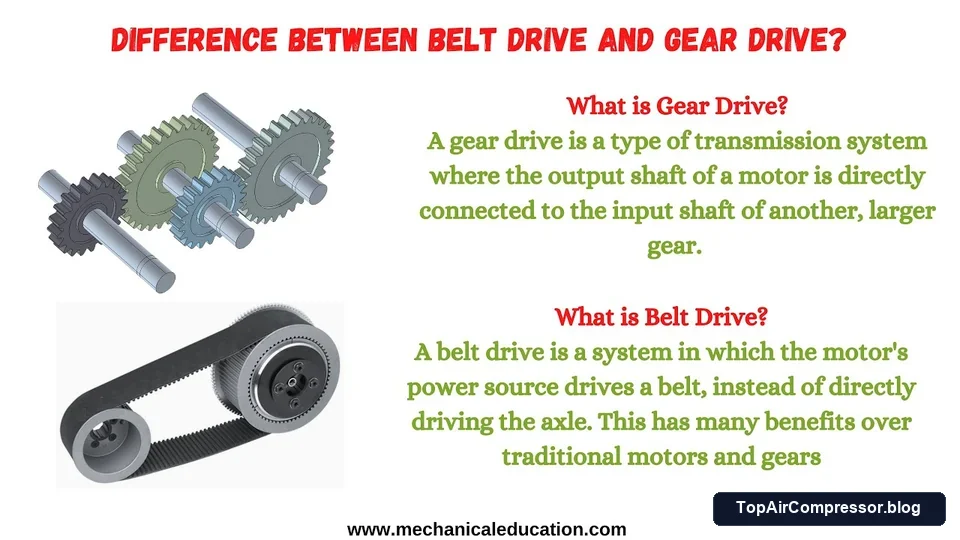
Direct drive configurations couple the motor shaft directly to the compressor crankshaft. Unlike options in our quietest compressor guide, this rigid connection eliminates intermediate components and transfers rotational force instantly.
Conversely, belt drive systems utilize pulleys and elastomer belts to transmit power from the motor to the pump flywheel. This introduces a mechanical gear ratio that alters operating speeds safely.
Belt drive systems utilize external pulleys and elastomeric V-belts to decouple the pump speed from the motor RPM. This mechanical ratio protects the electric motor from sudden crankshaft binding events.
Direct drive units couple the compressor pump directly to the motor shaft via a rigid coupling. Eliminating slip losses yields exceptional mechanical efficiency, but transfers high-frequency torsional shock directly to armature windings.
Engineers select belt drives for heavy industrial environments where speed reduction lowers operating temperatures. Conversely, direct drive architectures eliminate alignment maintenance, making them ideal for compact portable service trucks.
- Direct drive links motor and pump shafts together.
- Belt drive utilizes pulleys and specialized elastomer belts.
- Mechanical ratios alter pump RPM independently from motor speed.
The Physics of Rotary Power Transfer
Rotational dynamics dictate that eliminating intermediate components reduces mechanical power loss. Direct drive mechanisms achieve high initial efficiency by locking the motor and pump speeds together.
However, this rigid coupling forces the pump to spin at matching motor velocity. Operating at high revolutions per minute generates significant internal friction and thermal stress across critical components.
- Rigid coupling locks motor and pump RPM together.
- High RPM operation accelerates internal friction rates.
Performance Output and Volumetric Efficiency Dynamics
Evaluating pneumatic performance requires analyzing cubic feet per minute delivery relative to operating pressure. Belt drive compressors excel in high-volume environments because their pulley ratios allow the pump to run slower.
Slower pump speeds allow intake valves to seat completely during each stroke. This mechanical advantage maximizes volumetric efficiency, delivering sustained high CFM outputs without overheating the cylinder walls.
Direct drive pumps operate at double the rotational speed to compensate for smaller physical dimensions. This rapid cycling restricts intake valve response times, reducing overall air delivery efficiency.
Volumetric efficiency depends heavily on compressor pump RPM and thermal expansion rates. Following our air compressor belt guide helps units run below 1,200 RPM, minimizing valve throttling losses and maximizing actual CFM.
Direct drive compressors operate at motor synchronous speeds, often exceeding 3,450 RPM. While this high velocity generates impressive theoretical displacement numbers, elevated thermal buildup reduces overall volumetric efficiency during extended operation.
Technicians evaluating continuous pressure requirements must analyze downstream pneumatic tool demands against actual pump output curves. Pressure drop across internal valving can severely restrict peak CFM delivery under load.
- Pulley ratios permit slower, cooler pump operation.
- High pump speed restricts intake valve response times.
- Volumetric efficiency drops significantly during prolonged high-speed cycles.
CFM Delivery and Pressure Retention
Maintaining stable line pressure under heavy tool loads separates industrial equipment from consumer-grade hardware. Industrial belt configurations sustain working pressures effortlessly during continuous sandblasting tasks.
Direct drive alternatives experience rapid pressure drops when powering high-demand pneumatic tools like impact wrenches. Their smaller displacement pumps struggle to replenish tank reserves quickly enough.
- Industrial setups maintain stable pressure during heavy tool usage.
- Smaller displacement pumps struggle with rapid tank replenishment.
Thermal Management and Continuous Duty Cycles
Heat remains the primary enemy of pneumatic machinery, degrading lubricating oil and warping metal components. Belt drive compressors manage thermal loads efficiently due to massive cast-iron flywheels featuring cooling fins.
These large flywheels act as built-in cooling fans, forcing ambient air across the pump head. Unlike units in our portable tire air compressor review, this thermal management enables continuous industrial duty cycles.
Direct drive units pack motors and pumps into cramped housings with minimal airflow space. Without large cooling flywheels, these machines accumulate heat rapidly, necessitating mandatory cool-down intervals.
Heat dissipation dictates whether a compressor can sustain a 100% duty cycle. Cast iron belt-drive pumps feature expansive cooling fins and massive flywheels acting as centrifugal fans to lower ambient temperatures.
Direct drive pumps concentrate extreme thermal energy within a tightly sealed crankcase. Without substantial surface area for convection, oil viscosity degrades rapidly, demanding strict adherence to synthetic lubricant change intervals.
Operating direct drive units beyond their rated duty cycle accelerates thermal expansion between aluminum cylinders and steel piston rings, causing catastrophic scoring damage and premature ring failure in demanding production facilities.
- Cast-iron flywheels double as active cooling fans.
- Slow operating speeds prevent excessive internal heat buildup.
- Compact housings restrict airflow and trigger thermal overloads.
Mitigating Thermal Breakdown Risks
Excessive operating temperatures carbonize compressor oil, leading to catastrophic ring failure and scoring. Belt configurations maintain lower operating temperatures, preserving lubricant viscosity over thousands of working hours.
Direct drive operators must respect strict duty cycle ratings to prevent thermal breakdown. Ignoring these operational limits causes premature seal failure and costly motor burnout incidents.
- Lower operating temperatures preserve synthetic oil viscosity.
- Strict duty cycle adherence prevents catastrophic motor burnout.
Acoustic Signatures and Vibration Isolation Engineering
Jobsite noise regulations and workshop ergonomics make acoustic management a critical purchasing factor. Belt drive units operate significantly quieter because their pulleys absorb high-frequency mechanical harmonics.
The elastomer belt acts as a natural dampening barrier between the motor and pump. This separation prevents the transmission of harsh vibrational frequencies into the compressor chassis.
Direct drive compressors produce a shrill, high-pitched whine due to their direct mechanical coupling. Steel-on-steel connections transmit intense vibrations directly through the frame, increasing operator fatigue.
Sound generation in compressors correlates directly with rotational speed and mechanical impact forces. Low-speed belt drives typically generate manageable noise levels around 75 decibels, preserving hearing health in shared workspaces.
High-speed direct drive machines produce harsh, high-pitched whines often exceeding 85 decibels. This acoustic profile requires operators to wear certified hearing protection during prolonged pneumatic hammering or spray painting operations.
Effective vibration isolation relies on heavy-duty rubber isolators bolted between the chassis and frame. Unmitigated motor harmonics in direct drive systems can loosen fasteners and cause structural fatigue over time.
- Pulleys and belts absorb harsh mechanical harmonics.
- Elastomer materials dampen destructive vibrational energy transfers.
- Direct connections generate high-pitched whines and heavy vibrations.
Workshop Acoustics and OSHA Compliance
Exceeding workplace noise thresholds creates unsafe environments that violate strict safety standards. Belt-driven systems often operate well below hazardous decibel levels, improving overall shop communication safety.
High-RPM direct drive models frequently require operators to wear dedicated hearing protection. Their piercing acoustic signature can make enclosed workshop environments uncomfortable during long shifts.
- Belt units maintain safer workplace decibel output levels.
- High-RPM models mandate continuous personal hearing protection.
Maintenance Protocols and Component Service Lifespans
Long-term operational costs depend heavily on routine maintenance requirements and part replacement intervals. Belt drive equipment demands periodic tension adjustments, alignment checks, and occasional belt replacements.
Despite requiring these routine mechanical interventions, belt systems offer remarkable service longevity. Individual components like pumps and motors can be serviced or replaced independently when wear occurs.
Direct drive compressors boast maintenance-free designs with sealed bearings and oil-less pumps. However, when an internal component fails, the entire unit usually requires replacement rather than repair.
Routine belt inspection is mandatory for industrial reciprocating systems. Mechanics must check belt tension and pulley alignment every 500 hours to prevent premature friction wear and catastrophic power transmission failure.
Direct drive equipment eliminates belts and pulleys entirely, drastically reducing routine drivetrain oversight. However, sealed pump designs often require more frequent oil changes due to concentrated operating temperatures and sheer stress.
Overall component lifespan favors multi-cylinder belt-drive pumps, which routinely exceed ten thousand operational hours when properly serviced. Direct drive units generally experience a shorter service life under heavy industrial duty cycles.
- Belt systems require periodic tension checks and alignments.
- Modular construction allows individual component replacement.
- Direct drive units feature sealed, non-serviceable internal assemblies.
Long-Term Cost of Ownership Analysis
Initial purchase prices favor direct drive models, making them attractive for budget-conscious buyers. Yet, frequent replacement cycles due to non-serviceable parts increase lifetime operational expenditures.
Investing in robust belt-driven machinery incurs higher upfront expenses offset by decades of reliable service. Modular repairability ensures your initial equipment investment retains value over time.
- Initial savings vanish with frequent direct drive replacements.
- Modular repairability lowers long-term industrial equipment costs.
Physical Footprint, Mobility, and Jobsite Integration
Logistical constraints dictate whether an air compressor remains stationary or travels between remote locations. Direct drive models feature compact, lightweight configurations optimized for effortless truck bed loading.
Their streamlined vertical or horizontal pancake tanks fit easily into tight service vehicle spaces. Contractors working on framing or roofing sites rely heavily on this high level of portability.
Belt drive systems utilize heavy cast-iron pumps and large ASME tanks mounted on rigid frames. This substantial weight and sprawling footprint make frequent transportation impractical without specialized vehicles.
Physical layout dictates equipment selection for mobile contractors and stationary workshops alike. Belt-drive compressors feature bulky vertical or horizontal tanks with protruding belt guards that increase the overall machinery footprint.
Direct drive models offer a remarkably compact profile, fitting easily into crowded truck beds or small utility vehicles. Their integrated design reduces center of gravity, enhancing stability during rough transport conditions.
Jobsite integration requires balancing raw weight against lifting ergonomics. While stationary belt units require permanent shop anchoring, lightweight direct drive units allow rapid deployment for framing crews and finish carpenters.
- Direct drive models offer lightweight, portable jobsite mobility.
- Pancake and twin-tank configurations fit service vehicle spaces.
- Belt systems require permanent or semi-permanent shop placement.
Stationary Shop Layout Optimization
Permanent automotive and fabrication shops benefit immensely from stationary equipment placement. Belt drive compressors anchor securely to concrete floors, feeding complex hard-piped distribution networks efficiently.
Attempting to mobilize heavy belt-driven machinery introduces severe safety hazards and structural frame damage. Keeping these units stationary maximizes output reliability across extensive pneumatic loops.
- Stationary units anchor securely to workshop concrete floors.
- Fixed setups feed extensive hard-piped air distribution networks.
Strategic Application Matching for Professional Workloads
Matching compressor architecture to specific daily tasks prevents frustrating bottlenecks and premature equipment failure. Professional carpenters and mobile contractors need lightweight, fast-cycling direct drive air power.
Automotive technicians, metal fabricators, and painters require continuous, high-volume air delivery capabilities. Belt drive compressors satisfy these demanding industrial workloads without experiencing thermal shutdowns.
Evaluating your peak CFM requirements, duty cycle frequency, and mobility needs clarifies the correct choice. Selecting the appropriate power transmission method guarantees optimal productivity across all professional applications.
Matching air compressor architecture to professional tasks prevents premature equipment failure. Heavy-duty manufacturing facilities demand continuous air delivery, making units highlighted in our best belt driven air compressor review the undisputed industry standard.
Conversely, residential contractors and mobile service technicians benefit from lightweight, low-maintenance direct drive systems. These units excel at intermittent tasks like framing, roofing, and finish nailing where portability matters most.
Facility managers must carefully analyze peak air consumption rates and available electrical infrastructure before purchasing. Selecting the wrong drive mechanism guarantees elevated operating costs and reduced operational efficiency across the lifespan.
- Mobile contractors require lightweight, fast-cycling direct drive tools.
- Fabrication shops demand continuous high-volume belt delivery.
- Matching architecture to workload eliminates frustrating operational bottlenecks.
Avoiding Costous Specification Mismatches
Deploying a direct drive unit on an assembly line guarantees rapid thermal overload shutdowns. The continuous demand overwhelms the small pump displacement and uncooled motor windings.
Conversely, installing a massive belt-driven compressor in a mobile service truck overloads electrical charging systems. Careful engineering analysis prevents these costly equipment specification mismatches entirely.
- Industrial tasks overwhelm small direct drive pump capacities.
- Heavy belt systems overload mobile vehicle electrical charging.
Frequently Asked Questions
Why do belt drive compressors run much quieter than direct drive models?
Belt drive units utilize pulleys and rubber belts that absorb high-frequency mechanical vibrations. This dampening effect significantly reduces the overall operational noise levels heard inside the workshop.
Can I use a direct drive compressor for continuous industrial sandblasting?
Direct drive compressors feature limited duty cycles and cannot handle continuous high-volume workloads. Sandblasting applications require the sustained airflow and thermal management provided by belt systems.
How often should I inspect and adjust the belt on my compressor?
You should inspect drive belts every three months for cracking, wear, and proper tension. Maintaining correct tension prevents premature belt slippage and protects motor bearings from damage.
Are direct drive air compressors completely maintenance-free during their lifespan?
Most models feature oil-less pumps and sealed bearings that eliminate routine internal lubrication tasks. However, you must still drain tank moisture regularly to prevent dangerous internal corrosion.
Which compressor type offers a better long-term return on investment?
Belt drive compressors deliver superior longevity and modular repairability for stationary shop environments. Industrial belt systems outlast direct drive units by decades under heavy professional workloads.