Difference Between Single Stage And Multistage Compressor vs. Standard Air Compressor: Which Fits Your Setup Better?
Selecting the right compressed air architecture demands careful analysis of pressure thresholds, volumetric output, and operational duty cycles. Evaluating single-stage versus multistage systems clarifies which industrial blueprint matches your specific facility demands.

Facilities requiring continuous high-pressure air should invest in multistage compressors for superior volumetric efficiency. Light automotive shops and general contractors will find standard single-stage units provide adequate pneumatic performance for standard tools.
Compare all top models in our Best Air Compressor: Top Picks for Every Garage & Roadside.
Side-by-Side Breakdown
| Criteria | Difference Between Single Stage And Multistage Compressor | Standard Air Compressor | Edge |
|---|---|---|---|
| Peak Performance & Output | High pressure and superior CFM capacity | Moderate pressure suitable for basic tools | Difference Between Single Stage And Multistage Compressor |
| Duty Cycle & Consistency | Continuous 100% duty cycle capability | Intermittent duty cycle requiring cool-down | Difference Between Single Stage And Multistage Compressor |
| Operating Noise & Vibration | Higher mechanical vibration requiring pads | Standard noise levels with easy mobility | Standard Air Compressor |
| Portability & Footprint | Stationary heavy footprint with large tanks | Compact portable or vertical configurations | Standard Air Compressor |
| Maintenance & Service Life | Complex multi-cylinder maintenance routine | Simple single-piston maintenance checks | Standard Air Compressor |
| Power Requirements | Requires heavy-duty three-phase electrical service | Operates on standard single-phase outlets | Standard Air Compressor |
| Best Ideal Use-Case | Automated factories and heavy industrial plants | General carpentry and light auto repair | Difference Between Single Stage And Multistage Compressor |
Mechanical Architecture and Compression Fundamentals
Understanding compressed air fundamentals begins with analyzing how atmospheric air transforms into usable pneumatic power. Positive displacement pumps dictate how effectively a reciprocating machine handles varying shop demands and heavy pneumatic workloads.
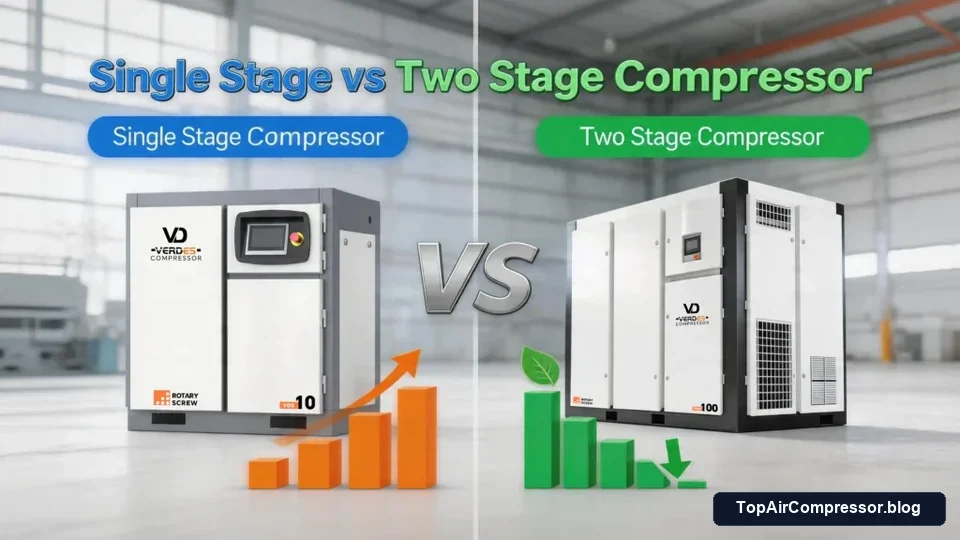
Single-stage compressors utilize one piston stroke to compress air directly into the receiver tank. This straightforward mechanical pathway introduces distinct operational limitations regarding maximum attainable discharge pressure within standard industrial frameworks.
Single-stage units utilize one piston stroke to compress atmospheric air directly to target storage pressure. Selecting our top 60 gallon single stage models ensures reliable performance for demanding workshop applications up to 150 psi.
Multistage systems pass air sequentially through two or more distinct cylinders. The initial low-pressure cylinder feeds a smaller high-pressure cylinder, achieving pressures exceeding 200 psi with reduced mechanical stress.
- Atmospheric intake draws ambient air directly into the primary cylinder chamber.
- Single pistons complete intake and compression strokes in rapid mechanical sequence.
- Discharge valves release compressed air instantly into storage reservoirs.
Single-Stage Compression Mechanics
Standard reciprocating units rely on a single piston acting within a single cylinder bore. Pneumatic energy generated here suits intermittent tasks requiring pressures typically under one hundred PSI.
Operators must monitor heat buildup because compressing air in one continuous stroke generates extreme temperatures. Thermal fatigue frequently limits continuous tool operation in smaller single-stage workshop configurations.
- Simplified valving reduces initial equipment acquisition costs.
- Single cylinder designs facilitate straightforward field servicing.
Multistage Thermal and Pressure Dynamics
Multistage systems divide the compression process across two or more separate cylinders of decreasing size. Interstage cooling drops air temperature between stages, dramatically improving overall thermodynamic efficiency and mechanical safety.
High-pressure output exceeding 175 PSI becomes entirely achievable without risking catastrophic valve failure or lubricant breakdown. Precision engineering ensures sustained volumetric output across heavy industrial pneumatic distribution networks.
- Decreasing cylinder sizes optimize mechanical advantage progressively.
- Interstage cooling jackets dissipate extreme operational heat efficiently.
Volumetric Output and Pressure Capabilities
Evaluating cubic feet per minute ratings clarifies how many pneumatic tools a compressor can simultaneously support. Volumetric output dictates whether your facility experiences pressure drops during peak manufacturing operational hours.
Standard single-stage compressors typically deliver lower CFM ratings at modest operating pressures suited for nail guns. Reviewing our best single stage air compressor picks highlights ideal units offering sustained high pressure reliably.
Volumetric efficiency drops significantly when single-stage pumps operate near their maximum thresholds. Heat buildup expands incoming air, reducing the true mass flow delivered per actual cubic foot of displacement volume.
Multistage compressors maintain superior volumetric output at higher PSI ratings by dividing compression ratios. Interstage cooling shrinks the air volume before secondary compression, optimizing total cubic feet per minute delivery metrics.
- Single-stage units excel at high CFM output at lower pressure thresholds.
- Multistage compressors generate superior pressures exceeding 150 PSI for demanding applications.
- Matching compressor displacement to tool consumption prevents costly pneumatic starvation.
Balancing Pressure and Flow
Balancing pressure and flow requirements prevents premature equipment wear and tool degradation. Optimal pneumatic sizing guarantees consistent tool torque delivery across extended production runs.
Industrial operations require careful calculations to account for peak air consumption spikes. Accurate CFM matching avoids oversized power bills and underpowered pneumatic actuators.
- Calculate total air consumption before selecting compressor architecture.
- Account for future facility expansion during equipment sizing phases.
Thermal Management and Intercooling Systems
Heat represents the primary enemy of pneumatic equipment, degrading lubricating oils and accelerating valve wear. Effective intercooling removes latent thermal energy between compression stages, protecting internal metallic components from stress.
Without intercoolers, single-stage units accumulate excessive heat that radiates throughout the crankcase and discharge lines. Thermal overload protection must be integrated to prevent motor burnout during extended operating shifts.
Single-stage compressors rely entirely on ambient airflow across external cast-iron cooling fins. Without intermediate heat rejection, discharge temperatures can easily exceed three hundred degrees Fahrenheit during prolonged operating cycles.
Multistage units incorporate finned intercoolers between compression stages to dissipate latent heat. Exploring the best airbrush and compressor kits helps you maintain proper compressor oil life during continuous operations.
- Excessive heat causes rapid breakdown of conventional compressor lubricating oils.
- Intercoolers lower the temperature of compressed air before secondary compression.
- Proper thermal management preserves the structural integrity of valve reeds.
Heat Dissipation in Multistage Units
Intercoolers utilize finned tubing or forced-air blowers to cool air passing between low and high-pressure cylinders. Lower operating temperatures drastically reduce moisture formation, protecting downstream pneumatic tools from corrosion.
Thermal efficiency gains directly translate to reduced energy consumption over long operating hours. Advanced heat dissipation extends compressor lifespan significantly in demanding environments.
- Finned intercoolers maximize surface area for rapid heat transfer.
- Interstage moisture separation protects delicate internal cylinder walls.
Duty Cycles, Run-Times, and Facility Workloads
Duty cycle percentages dictate how many minutes per hour a compressor motor can safely operate. Evaluating our best two stage air compressor guide clarifies continuous duty ratings for industrial workshops.
Exceeding recommended duty cycles on standard units causes premature motor failure and warped valve reeds. Facilities requiring uninterrupted air supply must deploy robust multistage compressors equipped with ASME storage tanks.
Standard single-stage reciprocating compressors typically feature a fifty percent duty cycle. Operating these machines continuously under heavy industrial loads risks catastrophic motor failure and accelerated cylinder bore wear.
Multistage industrial units frequently support continuous 100 percent duty cycles. Their robust thermal architecture easily handles demanding manufacturing environments where pneumatic tools require uninterrupted, steady-state line pressure.
- Intermittent duty cycles require frequent cool-down periods for motor longevity.
- Continuous duty systems run indefinitely without overheating critical electrical windings.
- Proper sizing prevents excessive motor cycling and electrical grid strain.
Workload Optimization Strategies
Optimizing facility workloads involves matching compressor capabilities with specific operational demands. Strategic equipment placement minimizes pressure losses across extensive workshop piping networks.
Monitoring daily air consumption patterns helps maintenance teams schedule preventive service windows effectively. Data-driven management reduces unexpected downtime and expensive emergency repairs.
- Track daily pressure fluctuations using digital inline monitoring gauges.
- Isolate high-demand pneumatic tools onto dedicated compressor lines.
Maintenance Protocols and Long-Term Durability
Routine maintenance ensures your compressed air infrastructure delivers reliable performance over decades of demanding service. Preventive maintenance schedules must incorporate regular oil changes and air filter inspections.
Standard single-stage pumps feature simpler internal layouts requiring minimal specialized tooling for basic valve rebuilds. Multistage rebuilds demand precise torque specifications and careful alignment of multiple cylinder heads.
Single-stage systems demand frequent valve inspections due to elevated operating temperatures. Mechanics must clean external cooling fins regularly to prevent thermal runaway and maintain baseline pump efficiency.
Multistage compressors require rigorous intercooler flushing and meticulous moisture trap maintenance. Condensate removal prevents internal corrosion within interstage piping, thoroughly safeguarding the heavy-duty cast-iron pump blocks.
- Daily moisture drain procedures prevent internal tank corrosion and pitting.
- Synthetic compressor oils extend service intervals in high-heat industrial environments.
- Regular belt tension checks eliminate unnecessary friction and mechanical power loss.
Component Inspection and Replacement
Scheduled inspections catch minor component wear before it triggers catastrophic compressor failure. Regular belt checks and valve cleanings maintain peak volumetric efficiency.
Replacing intake air filters promptly prevents abrasive dust from scoring cylinder walls. Quality replacement parts ensure your compressed air system meets original manufacturer specifications.
- Inspect compressor check valves for carbon buildup and leakage.
- Test pressure relief valves periodically to guarantee safety compliance.
Footprint, Installation, and Vibration Control
Physical dimensions and weight dictate where and how you install your new compressor system. Vertical tank configurations save valuable floor space in cramped automotive repair facilities and fabrication shops.
Larger multistage units require reinforced concrete pads to absorb significant vibration generated by massive pistons. Isolation pads minimize structural resonance and protect surrounding machinery from harmful vibrational energy transfer.
Single-stage configurations feature compact horizontal or vertical tank mountings. Their lighter reciprocating masses demand standard anchoring, making them ideal for mobile service trucks and tight shop footprints.
Multistage systems typically require heavy baseplate foundations with dedicated vibration isolators. Balanced multi-cylinder layouts reduce dynamic shaking forces, yet their massive physical dimensions demand permanent facility floor space.
- Portable single-stage units offer mobility for remote job-site construction tasks.
- Stationary multistage compressors demand permanent installation with dedicated ventilation channels.
- Proper anchoring ensures safe operation under high-pressure industrial load conditions.
Facility Integration and Ventilation
Proper room ventilation is essential for dissipating ambient heat generated by heavy compressor operation. Adequate airflow clearance prevents motor overheating and maintains high volumetric efficiency.
Positioning intake vents to draw clean outdoor air reduces internal contamination risks significantly. Strategic facility layout ensures easy access for routine maintenance technicians.
- Maintain minimum clearance distances around all compressor enclosure panels.
- Install ducted ventilation systems for enclosed mechanical equipment rooms.
Electrical Requirements and Energy Consumption
Electrical demands scale dramatically when moving from standard workshop compressors to industrial multistage equipment. Amperage draws frequently require specialized three-phase commercial power drops installed by certified electricians.
Energy efficiency improves significantly in multistage units due to near-isothermal compression across multiple cylinder stages. Lower operating wattage per cubic foot of air delivered saves money over extended operational lifespans.
Single-stage compressors operate efficiently on standard single-phase electrical circuits. Starting amperage draws remain manageable for general commercial wiring, minimizing costly infrastructure upgrades for small automotive repair shops.
Multistage equipment frequently demands robust three-phase power supplies to handle high-horsepower motors. Isothermal compression efficiency reduces long-term operational costs when running heavy pneumatic loads across industrial production lines.
- Standard 115V or 230V single-phase power suffices for most single-stage setups.
- Heavy-duty industrial units mandate 460V three-phase electrical service connections.
- Energy audits help facilities optimize compressor run times and reduce overhead.
Power Management and Efficiency
Managing electrical consumption involves monitoring peak load demands and motor start currents. Soft-start controllers reduce mechanical shock and prevent breaker trips during motor startup phases.
Evaluating power factor correction units helps large facilities minimize commercial electrical penalty fees. Energy-efficient motors lower long-term operating costs across continuous production schedules.
- Verify electrical service capacity before purchasing high-horsepower units.
- Utilize variable speed drives where fluctuating air demands occur.
Frequently Asked Questions
What is the main structural difference between single-stage and multistage compressors?
Single-stage units utilize a single piston stroke to compress atmospheric air directly into the receiver tank for immediate workshop use.
Conversely, multistage compressors utilize sequential cylinders of decreasing size combined with intercoolers to achieve significantly higher discharge pressures with superior overall energy efficiency and reduced thermal stress.
Can a standard single-stage compressor handle heavy industrial manufacturing workloads?
Standard single-stage compressors feature limited duty cycles and cannot sustain the continuous high pressure required by automated manufacturing lines or heavy assembly plants.
Therefore, demanding industrial facilities always need robust multistage compressor systems to prevent thermal overload, motor burnout, and frustrating production downtime.
Why are intercoolers necessary in multistage compressor configurations?
Intercoolers remove the intense thermal energy generated during the initial low-stage compression cycle before air enters subsequent cylinders. This crucial cooling process prevents lubricant breakdown and moisture accumulation, ensuring maximum volumetric efficiency and prolonged equipment lifespan.
What electrical upgrades are typically required for industrial multistage compressors?
Many heavy-duty multistage compressors demand high-voltage three-phase electrical service rather than standard single-phase workshop outlets. Facility managers must consult licensed electricians to verify adequate panel capacity and install appropriate wiring before equipment delivery.
How often should maintenance be performed on reciprocating air compressors?
Routine maintenance schedules require checking oil levels daily, draining tank moisture weekly, and inspecting filter elements monthly. Following these strict preventive maintenance protocols guarantees optimal performance and prevents premature mechanical failure across all compressor types.