Hot Dog vs. Pancake Air Compressor: Which Fits Your Setup Better?
Choosing the right portable compressed air system requires weighing horizontal tank geometry against vertical pancake designs. Understanding structural trade-offs prevents costly workflow bottlenecks on job sites.


Select the hot dog compressor for stable horizontal placement and continuous trim work. Choose the pancake compressor when maximizing vertical floor space and easier trunk storage matter most.
Compare all top models in our Best Air Compressor: Top Picks for Every Garage & Roadside.
Side-by-Side Breakdown
| Criteria | Hot Dog | Pancake Air Compressor | Edge |
|---|---|---|---|
| Peak Performance & Output | 1-2 gal horizontal dual tank, 2.0 SCFM @ 90 PSI | 1-6 gal flat round tank, 1.5 SCFM @ 90 PSI | Hot Dog |
| Duty Cycle & Consistency | Moderate cycle with balanced motor load | Rapid recovery with compact pump | Tie |
| Operating Noise & Vibration | Lower center of gravity reduces walk | Compact footprint generates higher base vibration | Hot Dog |
| Portability & Footprint | Longer chassis requires more length | Stacked round profile stores easily | Pancake |
| Maintenance & Service Life | Standard oil-less pump maintenance | Direct-drive pump needs routine checks | Tie |
| Power Requirements | 120V standard household circuit | 120V standard household circuit | Tie |
| Best Ideal Use-Case | Finish carpentry and staple guns | Inflation and brad nailing | Hot Dog |
Architectural Anatomy and Tank Geometry Fundamentals
Tank geometry dictates how pneumatic energy stores inside portable reciprocating units. Horizontal cylinders distribute mass along a linear axis, creating a stable platform during high-pressure operation.
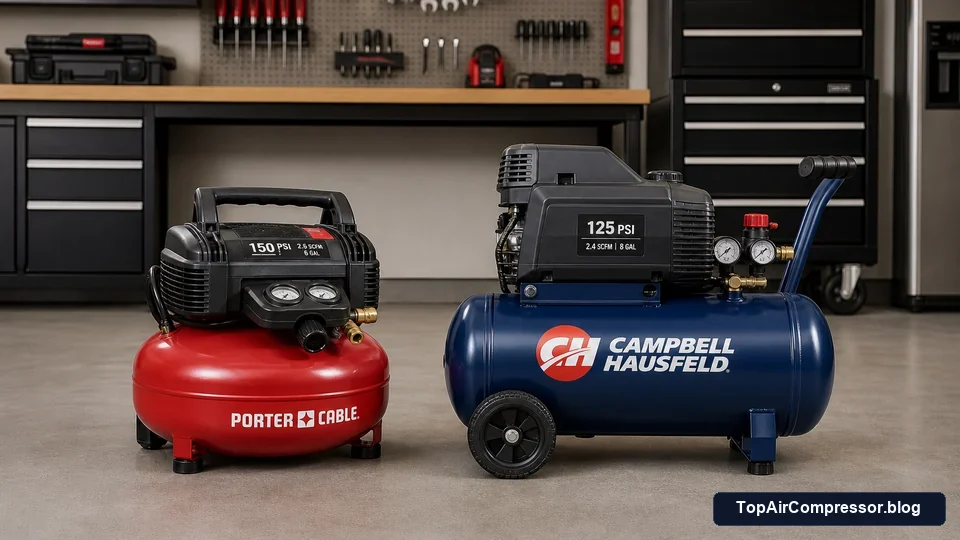
Conversely, circular flat reservoirs utilize a vertical stacking method. This design concentrates total weight above a compact base, altering the center of gravity significantly.
Hot dog compressors feature a single, horizontal cylindrical receiver tank welded from heavy-gauge steel. This geometry prioritizes a low center of gravity, making them stable on uneven work surfaces and scaffolding platforms.
Conversely, pancake units utilize a flat, circular, disc-shaped pressure vessel welded vertically. This compact radial design minimizes horizontal floor space consumption, though it elevates the overall vertical center of gravity during transit.
- Cylindrical shell wall thickness
- Weld seam integrity standards
- ASME pressure vessel compliance
Horizontal Cylinder Mechanics
While similar to options featured in our best pancake air compressor guide, horizontal twin tanks utilize parallel steel tubes to increase available air volume and balance internal pressure.
Technicians appreciate how this configuration prevents accidental tipping during transit. The elongated stance absorbs mechanical torque effectively during pump startup phases.
- Extended wheelbase stability
- Balanced torsional stress load
Vertical Pancake Design Physics
Pancake units rely on a circular receiver welded to a central baseplate. Vertical stacking minimizes the horizontal footprint for tight storage spaces.
However, this elevated center of gravity demands secure footing on uneven scaffolding. Technicians must anchor the unit properly to prevent shifting during rapid pressure cycling.
- Minimal floor space footprint
- High center of gravity profile
Pneumatic Performance and Air Delivery Dynamics
Delivering consistent standard cubic feet per minute requires efficient pump displacement. Pneumatic output determines whether your pneumatic tool operates without frustrating pressure drops.
When evaluating options in our best hot dog air compressor roundup, units often feature dual-tank layouts that boost storage capacity and maintain steady working pressure during intermittent tasks.
Tank geometry directly impacts volumetric efficiency and condensate pooling mechanics within portable receivers. Hot dog configurations allow moisture to spread across a wider baseline, whereas pancakes concentrate water directly beneath the center drain port.
Effective air delivery relies on pump displacement ratings matched to standard SCFM benchmarks at ninety PSI. Pressure drop characteristics differ slightly due to internal manifold lengths and rapid expansion rates inside the contrasting vessel shapes.
- SCFM delivery ratings at 90 PSI
- Pump recovery time benchmarks
Air Volume and Recovery Speed
Rapid recovery hinges on efficient motor horsepower matched with small displacement pumps. Thermal management prevents overheating during sustained fastening applications on busy job sites.
Pancake compressors excel at quick initial pressurization due to smaller internal cavity volumes. Yet, they deplete faster under heavy sustained tool loads like framing nailers.
- Fast initial tank fill times
- Pressure drop under continuous load
Ergonomic Transportability and Jobsite Footprint
Jobsite mobility heavily influences tool selection among professional contractors and serious hobbyists. Carrying comfort depends on handle placement and overall weight distribution across your body.
Pancake units offer exceptional trunk storage capabilities due to their compact circular dimensions. They slide easily beneath shelving units or inside crowded vehicle compartments without hassle.
Carrying dynamic loads requires evaluating weight distribution and handle placement on jobsite compressors. Hot dogs stretch longer, requiring two-handed balancing or integrated wheel kits to prevent awkward leg scraping during long corridor walks.
Pancake models offer a tightly bundled footprint that tucks neatly against the operator's leg. Their centered lifting bails reduce lateral sway, though their taller vertical profiles can catch on low-hanging door frames or scaffolding braces.
- Vehicle trunk storage efficiency
- Balanced center-handle design
Handling Long-Form Chassis Units
Transporting horizontal twin-tank models requires accommodating their longer overall physical frame. Extended length demands dedicated cargo space despite their lower mounting profile.
Contractors often sling these horizontal machines over one shoulder using integrated carrying straps. The balanced weight distribution minimizes fatigue during extended walking distances.
- Shoulder strap compatibility
- Linear trunk layout requirements
Acoustic Engineering and Vibration Management
Operating noise levels impact jobsite communication and local ordinance compliance significantly. Decibel ratings dictate whether hearing protection is mandatory during indoor trim installation tasks.
Mechanical vibration, much like units evaluated in our best portable tire air compressor selection, can cause machines to walk across smooth concrete floors unless proper rubber isolation dampens destructive frequencies.
Noise mitigation involves isolating motor vibration from the steel tank shell to dampen structural resonance. Piston slap and intake flutter create distinct decibel profiles that vary based on pump housing thickness and rubber isolation mounts.
Pancake units frequently exhibit slightly different harmonic frequencies because their circular end caps reflect sound waves compactly. Operators should verify OSHA noise compliance thresholds when running either configuration inside enclosed residential remodeling environments.
- Decibel output at three feet
- Rubber dampening foot isolation
Mitigating Mechanical Resonance
Circular pancake frames frequently generate higher localized vibration due to their stacked geometry. Rigid mounting plates transfer more kinetic energy directly into underlying support surfaces.
Twin-tank horizontal systems absorb reciprocating forces better along their extended axis. This structural advantage reduces annoying creeping behavior during prolonged cycling periods.
- Axis force absorption rates
- Floor creep prevention metrics
Maintenance Protocols and Long-Term Durability
Routine maintenance extends operational lifespans for all portable oil-less reciprocating machinery. Moisture drainage prevents internal tank corrosion from compromising structural pressure vessel integrity.
Checking intake filters regularly ensures optimal airflow into the compression chamber elements. Neglecting this simple step reduces pump efficiency and accelerates valve wear prematurely.
Daily moisture drainage prevents internal oxidation and structural thinning of the steel pressure vessel walls. Both designs require reliable brass ball valves, but hot dog tanks demand careful tilting to flush accumulated condensate completely out.
Pump maintenance involves inspecting oil-free piston rings, cleaning intake air filters, and checking ASME safety valve integrity. Neglecting these routine checks accelerates thermal degradation, reducing motor lifespan and causing catastrophic pressure loss mid-task.
- Daily tank moisture drainage
- Intake filter element inspection
Pressure Vessel Inspection Standards
Steel tank walls endure cyclical stress every time the motor cycles onward. Corrosion monitoring remains essential for preventing catastrophic failure in aging high-pressure vessels.
Technicians should inspect exterior welds and safety relief valves every operational season. Complying with safety standards prevents hazardous ruptures on demanding commercial construction sites.
- Safety relief valve testing
- Weld seam corrosion checks
Electrical Demands and Power Draw Efficiency
Power requirements dictate where portable compressors can operate without tripping circuit breakers. Amperage draw must match standard 120-volt household electrical service limitations safely.
Extension cords introduce voltage drop that can overheat electric motor windings prematurely. Using heavy-gauge wire prevents motor damage during high-demand pneumatic tool operations.
Operating portable compressors on long extension cords demands strict attention to voltage drop and circuit breaker ratings. Drawing excessive starting amps will trip standard 15-amp breakers, causing frustrating work interruptions during heavy framing nailing sessions.
Universal motors found in these units require clean electrical inputs to prevent premature winding overheating. Using appropriately sized 12-gauge cords protects internal thermal overloads and maintains consistent motor RPM under heavy pneumatic load sequences.
- Standard 15-amp circuit compatibility
- Extension cord gauge requirements
Managing Motor Starting Amperage
Induction motors demand high starting current when overcoming head pressure inside tanks. Inrush current spikes test the limits of standard jobsite electrical distribution panels.
Pancake and hot dog units utilize similar universal or induction motor designs. Ensuring clean power delivery maximizes operational longevity across diverse residential remodeling environments.
- Inrush current management
- Motor winding thermal protection
Application Matching for Professional Workloads
Matching compressor output to specific pneumatic tools prevents frustrating workflow delays. Tool compatibility relies entirely on maintaining adequate SCFM delivery at required operating pressures.
Interior finish carpentry and brad nailing represent ideal workloads for these compact units. Heavy demolition scaling requires larger stationary workshop compressors instead.
Choosing between tank styles depends heavily on specific trade requirements and duty cycle demands. Models found in our best pancake air compressor for framing nailer guide suit tight professional spaces.
Evaluating maximum operating pressure alongside tank capacity ensures tools like brad nailers or staplers receive steady airflow. Matching equipment specifications prevents pressure starvation and guarantees reliable pneumatic tool cycling throughout demanding professional shifts.
- Finish nailer and stapler suitability
- Exclusion of heavy abrasive blasting
Sizing for Finish Carpentry Tasks
Trim carpenters require reliable air delivery for rapid-fire pin nailers and staplers. Continuous cycling ensures fasteners drive flush without leaving protruding heads behind.
Evaluating your daily fastener count helps determine whether a horizontal or vertical unit fits best. Selecting correctly boosts daily productivity and reduces equipment frustration.
- Pin nailer air consumption
- Fastener depth consistency checks
Frequently Asked Questions
Can I run a framing nailer off a pancake air compressor?
Running a heavy framing nailer on a compact pancake compressor is technically possible for very light framing tasks, but the rapid air depletion will cause constant workflow delays on site.
Continuous professional framing always requires a larger dual-tank or stationary wheeled unit to maintain adequate working pressure without constantly stalling the motor.
Which compressor style is easier to transport in a small car?
Pancake compressors are significantly easier to transport in small passenger cars because their unique vertical stacking geometry creates a remarkably compact physical footprint.
Vehicle storage becomes effortless since these circular units slide easily beneath other tools or inside crowded trunk compartments without taking up valuable cargo floor space.
Do hot dog compressors vibrate less than pancake models?
Hot dog compressors generally vibrate much less than pancake models because their extended horizontal dual-tank chassis distributes equipment mass along a wider linear axis on the ground.
Lower center of gravity engineering successfully prevents the machinery from walking across smooth concrete workshop floors during intense high-pressure pump cycles.
How often should I drain moisture from the tank?
You should always drain accumulated moisture from your portable compressor tank after every single day of heavy operation to prevent destructive internal rusting over time.
Daily moisture drainage protects the structural integrity of the steel pressure vessel from premature corrosion failure and significantly extends overall equipment lifespan.
Can I run an air brush or spray gun on these small units?
Small hot dog and pancake compressors can easily handle low-pressure artistic airbrushing tasks, but they struggle to maintain the continuous CFM required for standard automotive spray guns.
Finishing spray guns demand steady, uninterrupted airflow that quickly overwhelms the limited storage capacity and pump output of these compact portable units.