Inflator vs. Compressor: Which Fits Your Setup Better?
Selecting the right pneumatic tool requires understanding pressure versus volume dynamics. This rigorous guide compares dedicated tire inflators against versatile air compressors for engineering applications.


Choose a portable inflator for high-pressure, low-volume automotive tasks on the go. Select a multi-purpose air compressor when you need continuous airflow, storage tanks, and multi-tool pneumatic versatility.
Compare all top models in our Best Air Compressor: Top Picks for Every Garage & Roadside.
Side-by-Side Breakdown
| Criteria | Inflator | Compressor | Edge |
|---|---|---|---|
| Peak Performance & Output | High PSI / Low CFM | Moderate PSI / High CFM | Compressor |
| Duty Cycle & Consistency | Short runtime / Thermal limits | Continuous duty / Storage tank | Compressor |
| Operating Noise & Vibration | High frequency / Low decibel | High decibel / Piston rumble | Inflator |
| Portability & Footprint | Ultra-compact handheld | Heavy wheeled or stationary | Inflator |
| Maintenance & Service Life | Sealed unit / Non-serviceable | Oil/belt checks / Long life | Compressor |
| Power Requirements | 12V DC / Small lithium pack | 120V/240V AC or heavy gas | Inflator |
| Best Ideal Use-Case | Emergency roadside inflation | Garage framing and air tools | Compressor |
Fundamental Engineering Mechanics and Design Architecture
Dedicated inflators rely on micro-piston mechanisms designed specifically for high-pressure output. They compress small volumes of ambient air rapidly to seat tire beads without requiring large air storage tanks.
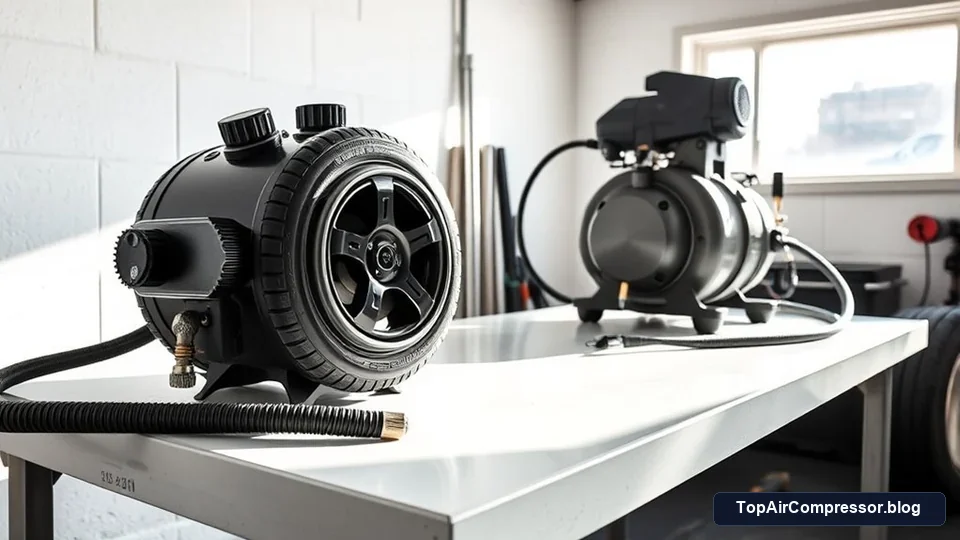
Conversely, standard air compressors utilize displacement pumps paired with ASME-certified receiver tanks. This architecture allows them to store pressurized air and deliver steady, high-volume flow for sustained pneumatic tool operation.
Portable inflators typically rely on oil-less diaphragm pumps or small piston designs optimized for high-pressure, low-volume outputs. Their direct-drive architecture minimizes mechanical complexity, making them lightweight for emergency roadside utility and consumer applications.
Standard shop compressors utilize robust cast-iron cylinders and reciprocating pistons or rotary screws to move massive air volumes. This heavy-duty engineering prioritizes continuous mechanical displacement over compact sizing, demanding stationary placement and dedicated electrical infrastructure.
- Micro-piston direct drive
- Receiver tank pressure storage
- Displacement pump engineering
Internal Component Variance
Inflator interiors feature direct-drive motors linked directly to miniature cylinders. This compact design reduces weight but limits overall mechanical leverage during heavy operational cycles.
Compressors incorporate crankshafts, connecting rods, and cast-iron cylinders designed for severe industrial service. Heavy-duty bearings manage thermal expansion under continuous mechanical load safely.
- Direct-drive miniature cylinders
- Industrial crankshaft assemblies
Volumetric Output, CFM Ratings, and Pressure Thresholds
Cubic feet per minute ratings dictate how quickly pneumatic equipment operates. Inflators deliver minimal CFM, focusing entirely on achieving high pounds per square inch ratings for automotive tires.
Air compressors excel in volumetric delivery, often exceeding several CFM at ninety psi. This high output drives impact wrenches, spray guns, and nailers without dropping supply pressure mid-task.
Inflators measure performance primarily in maximum PSI, often reaching 160, while delivering negligible cubic feet per minute. This narrow operational focus suits sealed vessels like tires rather than continuous pneumatic tools.
Conversely, standard compressors prioritize CFM delivery at specific pressure thresholds like 90 PSI to drive demanding equipment. Their volumetric efficiency allows them to sustain continuous operation without experiencing severe pressure drop during heavy tool activation.
- High PSI versus high CFM
- Cubic feet per minute metrics
- Pneumatic tool compatibility
Pressure Delivery Analysis
Reaching one hundred fifty psi is standard for quality portable units found within our best air compressor tire inflator guide. However, their volumetric output struggles to sustain even minor pneumatic tools.
Compressors balance manageable working pressures with massive air volume reserves. Their storage tanks act as buffers, absorbing peak demands that would stall direct-drive inflation devices instantly.
- One hundred fifty psi limits
- Storage tank pressure buffering
Duty Cycles, Thermal Management, and Operational Endurance
Thermal buildup remains the primary enemy of compact pneumatic devices. Most portable inflators require strict ten-minute rest periods after short run times to prevent catastrophic motor failure.
Workshop compressors utilize cast-iron pumps equipped with cooling fins and splash lubrication. These thermal mitigation features enable fifty percent to one hundred percent operational duty cycles daily.
Compact inflators suffer from extremely limited duty cycles, frequently requiring mandatory cooling periods after just ten minutes of continuous runtime. Their micro-motors accumulate heat rapidly due to minimal surface area for effective ambient dissipation.
Industrial compressors feature extensive thermal management systems, including ASME-rated storage tanks, finned copper tubing, and flywheel fans. These engineering safeguards permit fifty to one-hundred-percent duty cycles under heavy commercial shop conditions.
- Thermal overload prevention
- Continuous versus intermittent duty
- Cooling fin and oil lubrication
Extended Run-Time Realities
Pushing a model from our best car tire inflator portable air compressor selection past its rated duty cycle melts internal plastic gears quickly. Operators must monitor run times closely during large jobs.
Industrial compressors run continuously inside busy automotive shops without thermal shutdown. Their robust construction dissipates frictional heat effectively through heavy-duty aluminum or cast-iron cylinder heads.
- Plastic gear melting risks
- Industrial continuous shop runtime
Portability Metrics, Power Sources, and Field Ergonomics
Field technicians prioritize lightweight construction and compact storage footprints above all else. Inflators fit easily inside glove boxes, running seamlessly on standard twelve-volt auxiliary power outlets.
Stationary compressors demand dedicated floor space and heavy electrical grid connections. Wheeled contractor units offer mobility, yet their substantial weight requires ramps for vehicle loading.
Modern digital inflators emphasize exceptional portability metrics, weighing under five pounds and integrating rechargeable lithium-ion battery packs. Ergonomic pistol grips and integrated LED work lights enhance usability during nocturnal roadside emergencies or off-grid repairs.
Shop compressors require permanent installation or heavy wheeled frames because of substantial weight distribution and 120-volt or 240-volt electrical requirements. Moving them across job sites necessitates dedicated truck beds, pneumatic tires, and secure tie-down anchor points.
- Twelve-volt DC vehicle integration
- Heavy AC electrical requirements
- Compact storage footprint advantages
Power Supply Versatility
Modern inflators utilize rechargeable lithium-ion battery packs for complete cordless freedom. This versatility makes roadside emergencies manageable without tethering your vehicle to external cords.
Larger compressors require robust AC amperage or gasoline engines to turn heavy pumps. Extension cord voltage drops can severely damage electric compressor motors during operation.
- Rechargeable lithium battery packs
- AC amperage and voltage drops
Maintenance Protocols, Wear Items, and Long-Term Durability
Portable inflators feature sealed, maintenance-free designs that eliminate user-serviceable components. Once internal mechanical seals or miniature motors fail, replacement becomes the only viable economic option.
Compressors demand routine oil changes and filter checks to ensure longevity. Draining accumulated tank moisture prevents internal rust, allowing these machines to last decades with proper care.
Tire inflators feature sealed internal components with virtually zero routine maintenance requirements beyond checking hose gaskets. Their disposable nature means internal piston seals cannot be easily replaced once mechanical wear causes failure.
Stationary compressors demand strict preventative maintenance schedules, including weekly tank condensation draining, synthetic oil changes every five hundred hours, and periodic intake filter replacements to ensure extended mechanical lifespan.
- Sealed non-serviceable internal units
- Periodic oil and filter maintenance
- Receiver tank moisture drainage
Lifecycle Cost Projections
Replacing disposable inflators every few years adds up across commercial fleets. Investing in a serviceable compressor reduces long-term operational expenditures significantly for active workshops.
Preventive maintenance schedules protect your compressor investment against premature wear. Replacing worn check valves and drive belts keeps operational efficiency at peak engineering levels.
- Commercial fleet replacement costs
- Preventive valve and belt maintenance
Acoustic Footprint, Vibration Control, and Shop Environment
High-frequency motor whines characterize products listed inside our best portable air compressor pump digital tire inflator guide during operation. Their overall decibel output rarely disrupts residential neighborhoods during emergency nighttime tasks.
Piston compressors produce significant low-frequency rumble and high decibel levels. Whisper-quiet compressor models utilize enclosed dual-piston pumps to maintain acceptable noise thresholds inside residential garages.
Small inflators generate high-frequency whining noises often exceeding eighty-five decibels, lacking adequate internal baffling or sound-deadening cabinet enclosures. Their lightweight plastic housings amplify operational vibrations when placed directly on hard pavement or vehicle hoods.
Professional compressors mitigate operational noise through rubber vibration pads, belt-driven slow-turning pump heads, and enclosed metal cabinets. These engineering controls reduce ambient noise levels, protecting worker hearing during extended shifts in enclosed workshops.
- High-frequency motor whine
- Low-frequency piston rumble
- Decibel mitigation technologies
Vibration Isolation Engineering
Unbalanced micro-piston movement causes portable inflators to walk across smooth surfaces. Rubber feet or stabilizing pads are essential to prevent unwanted movement during high-pressure inflation cycles.
Stationary compressors anchor firmly to concrete shop floors using vibration-isolating pads. This engineering approach eliminates structural resonance and protects surrounding equipment from harmful harmonic vibrations.
- Rubber stabilizing footpads
- Concrete floor vibration isolation
Application Mapping and Professional Workload Selection
Matching equipment capabilities to your specific tasks prevents costly operational bottlenecks. Choose inflators exclusively for automotive tires, sports equipment, and inflatable recreational gear requiring high pressure.
Deploy versatile air compressors for framing, painting, sandblasting, and heavy maintenance work. Their massive air reserves and high CFM delivery handle demanding pneumatic workloads effortlessly.
Selecting the correct device dictates matching tool air requirements to volumetric output capabilities. Units featured in our best car tyre inflator air compressor pump lineup successfully handle bicycle tires and emergency vehicle top-offs.
Heavy pneumatic tasks like impact wrenching, orbital sanding, and paint spraying require the steady reserve capacity of a receiver tank compressor. Using an inflator for these commercial workloads causes immediate thermal overload and permanent motor burnout.
- Automotive tire inflation tasks
- Professional pneumatic tool operation
- Industrial maintenance workload matching
Multi-Tool Integration Matrix
Running pneumatic ratchets and paint sprayers demands steady CFM delivery. Only traditional compressors with appropriate tank capacities supply the uninterrupted airflow these demanding tools require.
Attempting to run shop tools with a portable inflator leads to immediate pressure starvation. Understanding these fundamental mechanical differences ensures you select the correct equipment.
- Steady CFM paint sprayer airflow
- Pressure starvation avoidance
Frequently Asked Questions
Can I use a tire inflator to run pneumatic impact wrenches in my home garage?
No, compact portable tire inflators completely lack the volumetric cubic feet per minute output required to successfully drive heavy mechanical air tools under sustained industrial load.
You must instead utilize a heavy-duty storage-tank air compressor to reliably maintain the continuous high airflow needed for professional pneumatic impact wrenches and high-torque automotive assembly ratchets.
Why do portable inflators overheat when filling large truck or tractor tires?
Portable inflators utilize small direct-drive micro-piston motors that generate extreme frictional heat rapidly during continuous high-pressure heavy vehicle tire inflation tasks.
Without adequate thermal cooling fins or robust mechanical oil lubrication, exceeding their strict manufacturer operational duty cycles will quickly melt internal plastic gears and permanently destroy the entire drive mechanism.
How often should I drain moisture from an air compressor storage tank?
You should manually drain accumulated condensation from your stationary receiver tank after every single day of heavy operational use in the shop.
Neglecting this crucial preventive maintenance step traps destructive moisture inside the metal vessel, causing rapid internal rust formation that can ultimately lead to catastrophic tank failure and dangerous pressurized ruptures.
Can a standard 12-volt inflator operate continuously using a vehicle cigarette lighter?
Most twelve-volt auxiliary vehicle power outlets feature strict ten-amp or fifteen-amp electrical fuse limits that severely restrict continuous power draw.
Running an unregulated portable air inflator past its rated operating duration can easily blow your vehicle fuse or melt auxiliary wiring harnesses due to excessive electrical resistance and sustained high current demand.
What is the main operational difference between oil-lubricated and oil-free compressors?
Professional oil-lubricated compressors utilize liquid oil baths to drastically reduce internal component friction, delivering exceptional operating longevity for demanding commercial workshop environments.
Conversely, standard oil-free models use specialized self-lubricating synthetic piston rings, offering convenient maintenance-free operation at the direct expense of accelerated mechanical wear over extended operational periods.