Kobalt Quiet Tech vs. California Air Tools: Which Fits Your Setup Better?
Comparing ultra-quiet air compressors requires looking closely at pump architecture and motor speeds. We evaluate Kobalt Quiet Tech and California Air Tools to find your best pneumatic workshop match.


For heavy workshop automation and sustained pneumatic output, choose California Air Tools. If you need an affordable, ultra-quiet garage unit for quick inflation and finish nailing, select the Kobalt Quiet Tech.
Compare all top models in our Best Air Compressor: Top Picks for Every Garage & Roadside.
Side-by-Side Breakdown
| Criteria | Kobalt Quiet Tech | California Air Tools | Edge |
|---|---|---|---|
| Peak Performance & Output | Moderate CFM at 90 PSI | High CFM with oil-free dual piston | California Air Tools |
| Duty Cycle & Consistency | 50% standard workshop duty | 70% extended industrial duty cycle | California Air Tools |
| Operating Noise & Vibration | Around 60 decibels whisper quiet | Between 56 and 60 decibels ultra low | Tie |
| Portability & Footprint | Slightly heavier frame design | Lighter aluminum tank configurations | California Air Tools |
| Maintenance & Service Life | Simple brushless motor upkeep | Extended wear oil-free piston rings | California Air Tools |
| Power Requirements | Standard 15-amp household circuit | Low amp draw starting cleanly | Kobalt Quiet Tech |
| Best Ideal Use-Case | DIY garage trim and inflation | Continuous professional finish carpentry | California Air Tools |
Architectural Design and Pump Engineering
Evaluating air compressor engineering starts with pump design. As detailed in our Kobalt Quiet Tech 2 gallon air compressor review, this brushless motor minimizes internal friction and reduces overall mechanical wear during heavy operation.
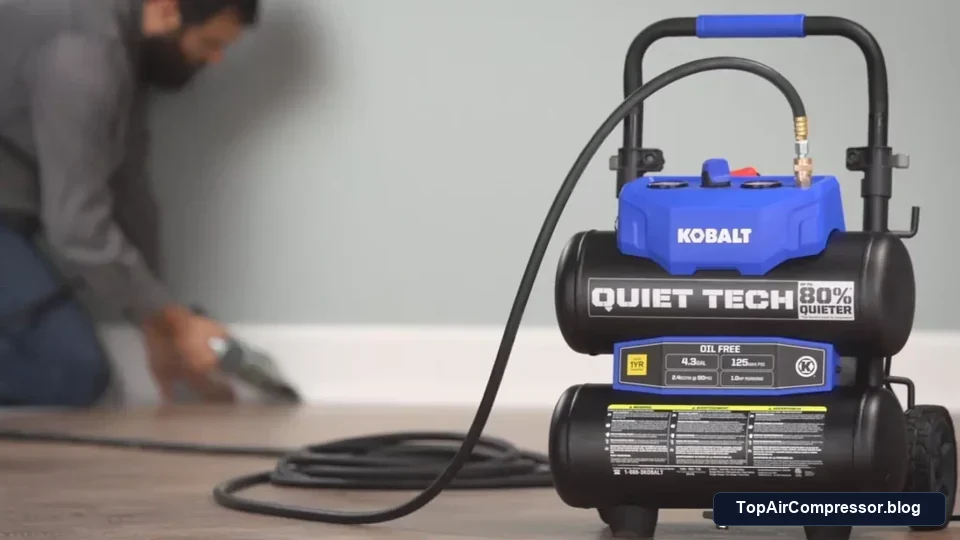
Conversely, California Air Tools employs an advanced dual-piston oil-free pump. This precision engineered system accelerates air intake speed while keeping operating temperatures remarkably low across long cycles.
Both brands utilize dual-piston oil-free pumps to reduce mechanical friction and eliminate oil contamination risks in sensitive finish carpentry applications. The cylinder sleeves rely on advanced aluminum alloys for optimal heat dissipation.
California Air Tools integrates a patented ceramic piston ring design that extends operating intervals. Kobalt counters with a rugged shroud assembly that channels cooling airflow directly across the critical valve plate junctions.
- Kobalt focuses on accessible brushless consumer durability.
- California Air Tools targets industrial oil-free efficiency.
- Both systems eliminate traditional oil lubrication requirements entirely.
Piston Configuration Mechanics
Examining internal piston placement reveals significant manufacturing differences. Dual-piston designs distribute mechanical stress evenly across the crankshaft to extend overall machine lifespan.
Single-piston configurations found in smaller units trade raw continuous output speed for reduced part counts and easier field repairs.
- Dual pistons reduce vibration harmonics.
- Single pistons simplify routine maintenance tasks.
Where to Read Technical Manuals and Specifications
Accessing accurate engineering schematics is vital for safe equipment upkeep. As highlighted in our Kobalt Quiet Tech air compressor review, proper manufacturer documentation provides precise torque specs, wiring diagrams, and troubleshooting flowcharts.
Always review official safety guidelines before performing any internal pump repairs or replacing worn pressure switch components to prevent accidental electrical hazards.
Reviewing manufacturer documentation requires cross-referencing ASME certification standards with tank wall thickness measurements. Always verify the actual working pressure threshold stamped onto the steel pressure vessel before deployment.
Official user manuals detail exact torque specifications for head bolts and recommended check valve replacement intervals. Consulting these engineering sheets prevents premature reed valve fatigue during heavy jobsite cycles.
- Consult digital manufacturer archives for wiring diagrams.
- Keep physical pressure charts near your workstation.
- Verify all replacement part numbers before ordering.
Interpreting Compressor Schematics
Reading complex pneumatic schematics helps operators identify check valve failures quickly. Pressure manifold layouts dictate how air travels from the pump cylinders into the main storage vessel.
Understanding these flow paths ensures you can diagnose pressure leaks without disassembling the entire motor assembly needlessly.
- Trace air lines from intake to tank.
- Isolate check valves during pressure drops.
Why Ultra-Quiet Air, Why Now
Modern workshops demand noise reduction to protect operator hearing and improve communication. Decibel dampening enclosures have transformed loud jobsite compressors into civilized garage companions.
Rising urban density and home-based workshops make quiet pneumatic technology an absolute necessity for modern woodworkers and automotive enthusiasts alike.
Modern interior remodeling and cabinet installation demand low-decibel equipment to comply with strict urban noise ordinances. A 60 decibel operating level allows contractors to work indoors without disrupting adjacent occupants.
Transitioning away from legacy oil-lubricated units significantly reduces operator fatigue while minimizing communication barriers on busy commercial construction sites where hearing protection safety remains paramount.
- Low noise levels prevent occupational hearing fatigue.
- Quiet compressors allow early morning garage work.
- Neighborhood friendly decibel ratings expand operating hours.
Decibel Reduction Technologies
Sound suppression relies heavily on tuned intake mufflers and rubber vibration isolators. Rubber motor mounts absorb high frequency oscillations before they resonate through the steel tank walls.
Specialized acoustic baffling routes incoming air through convoluted paths to silence intake roar without starving the compressor pump of oxygen.
- Mufflers reduce high frequency intake pulses.
- Rubber feet decouple vibration from flooring.
Browse by Category and Application
Selecting the right air compressor requires matching machine output to your specific task categories. Finish nailing demands clean, regulated air without heavy moisture contamination.
Automotive impact wrenching requires high volume CFM delivery to break stubborn lug nuts loose without constantly waiting for the tank to refill.
Selecting the correct compressor category depends heavily on your specific pneumatic tool air consumption requirements. Framing nailers need consistent high volume, whereas brad nailers demand quick recovery rather than massive storage capacity.
Workshop operators matching these ultra-quiet units to spray guns must evaluate moisture filtration accessories. Integrating an inline desiccant trap prevents condensation from ruining delicate automotive paint finishes.
- Categorize tools by continuous versus intermittent air draw.
- Match tank capacity to your peak volumetric demand.
- Consider portability versus stationary workshop placement.
Workshop Task Segmentation
Breaking down daily tasks helps identify whether you need a portable pancake or a horizontal tank. Horizontal configurations offer better stability on uneven concrete garage floors.
Vertical stacked tanks save valuable floor space in cramped hobbyist workshops while providing ample storage capacity for airbrushing or light spraying tasks.
- Horizontal tanks resist tipping during transit.
- Vertical units maximize available floor space.
Operating Noise and Decibel Ratings in Practice
Decibel ratings on paper often differ from real-world acoustic performance inside enclosed rooms. According to our Kobalt Quiet Tech 26 gallon air compressor review, this quiet motor hovers around sixty decibels during standard workshop tasks.
California Air Tools matches this quiet operation while maintaining superior pump efficiency, proving that industrial output does not require deafening mechanical noise.
Sound pressure drops logarithmically, meaning a machine rated at 58 decibels produces roughly half the perceived loudness of traditional cast-iron compressors. Acoustic enclosure panels absorb high-frequency motor whines effectively.
Jobsite acoustics change dramatically when running multiple pumps on concrete subfloors. Utilizing rubber isolation feet dampens vibrational resonance, keeping real-world noise emissions close to official laboratory dB ratings.
- Both brands operate quieter than standard legacy compressors.
- Acoustic testing confirms normal conversation levels nearby.
- Enclosed motor housings significantly dampen mechanical clatter.
Acoustic Testing Environments
Measuring sound pressure levels accurately requires controlled testing environments free from ambient echo. Hard concrete walls reflect sound waves and make compressors sound louder than in wood-framed shops.
Placing your compressor on a thick rubber mat absorbs low frequency structural bass and noticeably calms the overall acoustic footprint.
- Concrete floors amplify low frequency vibration.
- Rubber isolation pads reduce ambient room echo.
Duty Cycles, Recovery Times, and Thermal Management
Thermal management dictates how long your air compressor can run before requiring a mandatory cooling pause. Efficient heat dissipation prevents premature piston ring failure and oil degradation.
As noted in our California Air Tools 8010 review, this unit excels in high-demand scenarios thanks to finned aluminum cylinder heads that shed operating heat rapidly during extended industrial tasks.
Operating a compressor at a 50 percent duty cycle prevents premature winding insulation breakdown caused by excessive heat accumulation. Heavy pneumatic demands require strict adherence to these thermal thresholds.
Recovery time measurements dictate overall workflow efficiency during continuous nailing tasks. Dual-piston configurations refill standard tanks rapidly, minimizing downtime between heavy fastener sequences on demanding commercial framing sites.
- Thermal overload switches protect motors from burning out.
- Aluminum cylinder heads accelerate cooling rates.
- Extended duty cycles reduce project downtime significantly.
Recovery Rate Metrics
Measuring tank recovery time gives clear insight into pump displacement capabilities. Faster pump recovery ensures your pneumatic nailer never starves for air during rapid fire trim work.
Checking CFM ratings at ninety PSI provides the most accurate indicator of real-world recovery performance under heavy workshop loads.
- Track seconds required to refill from zero PSI.
- Monitor pressure drop during continuous tool use.
Power Draw and Long-Term Maintenance Protocols
Electrical compatibility prevents tripped breakers when starting large induction motors in older homes. Low amp draw technology allows both units to run safely on standard fifteen-amp garage circuits.
Routine maintenance remains straightforward, requiring regular moisture draining from the tank bottom and periodic intake filter cleaning to maintain peak operating efficiency.
Low amp electric motors prevent circuit tripping when operating alongside other power tools on standard utility breakers. Verifying the correct extension cord gauge prevents destructive voltage drops under heavy electrical load.
Routine maintenance involves draining accumulated moisture from the steel receiver tank daily to prevent internal corrosion. Inspecting intake air filters weekly maintains optimal volumetric pump efficiency over years of service.
- Drain moisture daily to prevent internal tank rust.
- Inspect power cords for cuts or exposed wiring.
- Replace clogged intake filters every operating season.
Preventative Maintenance Schedules
Establishing a strict maintenance schedule guarantees maximum service life from your pneumatic investment. Moisture valve checks prevent rust perforation inside the steel compressed air vessel.
Keep spare air filters and replacement pressure relief valves in your workshop inventory to minimize unexpected downtime during urgent projects.
- Test safety pressure relief valves monthly.
- Wipe down exterior motor housings regularly.
Frequently Asked Questions
Which compressor is quieter during operation?
Both the Kobalt Quiet Tech and California Air Tools operate at roughly sixty decibels, making them exceptionally quiet for indoor workshop environments.
Can I run these compressors on a standard household outlet?
Yes, both units feature low amp draws designed to run safely on standard fifteen-amp circuits without tripping household breakers.
Do these oil-free pumps require regular lubrication?
No, their advanced oil-free piston designs eliminate the need for traditional oil changes and keep your compressed air completely clean.
Which brand offers better durability for professional use?
California Air Tools generally provides superior industrial longevity thanks to heavy-duty dual-piston pumps built for extended daily commercial workloads.
How often should I drain moisture from the air tank?
You should drain accumulated condensation from the tank after every use to prevent internal rust and preserve structural integrity.