Piston vs. Rotary Screw Air Compressor: Which Fits Your Setup Better?
Choosing the right compressed air architecture dictates your facility's operational efficiency. This technical comparison contrasts reciprocating piston units against continuous-duty rotary screw systems.

Choose a reciprocating piston setup for intermittent shop applications requiring high pressure. Invest in a rotary screw compressor when your facility demands continuous duty and steady industrial airflow.
Compare all top models in our Best Air Compressor: Top Picks for Every Garage & Roadside.
Side-by-Side Breakdown
| Criteria | Piston | Rotary Screw Air Compressor | Edge |
|---|---|---|---|
| Peak Performance & Output | High pressure, lower total volume | High continuous volume, stable pressure | Rotary Screw |
| Duty Cycle & Consistency | 50 percent maximum duty cycle | 100 percent continuous duty cycle | Rotary Screw |
| Operating Noise & Vibration | Loud, high structural vibration | Quiet, balanced rotational dynamics | Rotary Screw |
| Portability & Footprint | Compact portable or horizontal tanks | Compact vertical industrial cabinetry | Rotary Screw |
| Maintenance & Service Life | Frequent valve and ring service | Minimal maintenance, long service intervals | Rotary Screw |
| Power Requirements | Single or three-phase standard power | Stable three-phase electrical supply | Piston |
| Best Ideal Use-Case | Auto shops and intermittent tasks | Manufacturing plants and factories | Rotary Screw |
Fundamental Mechanical Architecture and Compression Cycles
Piston compressors rely on reciprocating pistons driven by a crankshaft within cylinders. Intake and exhaust valves manage air movement during specific strokes, generating significant heat and pulsating airflow profiles.
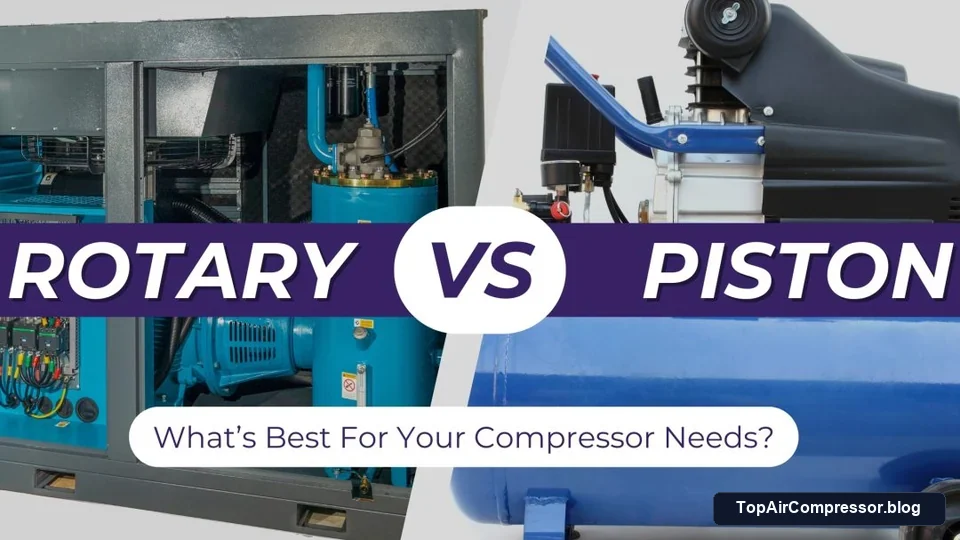
Rotary screw machines utilize two counter-rotating helical rotors trapped inside a precision housing. While large screws serve factories, our portable air compressor for tools review highlights versatile options built for demanding job sites.
Understanding these foundational mechanical differences clarifies why reciprocating units suit intermittent demands while rotary designs excel under relentless, round-the-clock industrial operating schedules and harsh factory floor environments.
Reciprocal units use crankshaft-driven pistons inside steel cylinders, converting rotational motion into linear displacement. This positive displacement method creates pulses requiring heavy receiver tanks to smooth downstream pressure fluctuations effectively.
Rotary screw systems utilize counter-rotating helical rotors that trap air in progressively smaller pockets. Oil injection seals internal clearances, lubricating meshing teeth while absorbing the massive heat generated during continuous operation.
Understanding volumetric efficiency requires analyzing internal leakage paths. Reciprocating rings wear over thousands of hours, whereas tight manufacturing tolerances in screw units maintain stable volumetric performance throughout their operating lifespan.
- Reciprocating piston pumps use crankshafts and intake valves.
- Rotary screw units utilize interlocking helical rotors.
- Continuous airflow is inherent to rotary screw designs.
Volumetric Efficiency and Mechanical Losses
Reciprocating piston pumps experience volumetric efficiency drops due to clearance volume trapped above the piston head. Residual compressed air expands on the intake stroke, reducing net volumetric output.
Rotary screw systems minimize internal leakage through tight manufacturing tolerances and oil injection sealing. This design achieves high volumetric efficiency across a broader operating pressure range without degradation.
- Clearance volume affects piston volumetric output.
- Tight manufacturing tolerances seal rotary screw chambers.
Performance Output, Pressure Ranges and Air Delivery
Piston pumps easily achieve high discharge pressures exceeding 175 PSI without complex multi-staging. However, their intermittent duty cycle limits total cubic feet per minute delivery over extended intervals.
Our best rotary screw air compressor guide highlights industrial units dominating continuous airflow delivery. These systems produce massive CFM output figures at stable working pressures between 100 and 150 PSI.
Selecting the correct technology depends heavily on your peak pneumatic tool consumption patterns and whether your operation requires sustained pressure or high burst capabilities.
Standard single-stage reciprocating compressors typically deliver maximum pressures up to 125 PSI, while two-stage variants easily push past 175 PSI for demanding pneumatic tools and heavy industrial applications.
Rotary screw compressors excel at continuous high-volume output, often measured in cubic feet per minute. They sustain steady line pressure without the wide drops typical of intermittent reciprocating pressure cycles.
Volumetric output degradation over time differs fundamentally between designs. Piston valves experience progressive carbon buildup and seat wear, whereas properly filtered screw compressors retain rated delivery capacities for decades.
- Pistons excel at higher discharge pressures.
- Rotary units deliver superior continuous volume.
- Match technology to peak tool consumption patterns.
Managing Thermal Loads and Heat Rejection
Reciprocating compressors generate intense localized thermal spikes around the cylinder head and exhaust valves. Effective intercoolers and cooling fins are mandatory to prevent lubricating oil breakdown.
Rotary screw systems circulate vast quantities of compressor oil directly into the compression chamber. This fluid acts as a coolant, sealant, and lubricant, maintaining remarkably low discharge temperatures.
- Cylinder heads experience severe thermal spikes.
- Oil circulation cools rotary compression chambers.
Duty Cycle Capabilities and Thermal Management
Operating a piston compressor beyond its rated 50 percent duty cycle invites catastrophic thermal failure. Motors require distinct rest periods to cool down, preventing overheating of the cylinder walls.
Rotary screw air compressors boast a 100 percent duty cycle rating, designed for continuous running without interruption. Heavy industrial plants rely on this capability to maintain uninterrupted pneumatic production lines.
Forcing a reciprocating machine into continuous-duty service drastically shortens its lifespan and escalates maintenance expenditures. Matching equipment duty ratings to actual facility demand remains paramount for reliability.
Reciprocal machines generally operate on a 50 percent duty cycle, requiring mandatory cooling intervals to prevent catastrophic valve warping and excessive crankcase oil temperatures under heavy industrial loads.
Rotary screw systems engineered for heavy manufacturing support a continuous 100 percent duty cycle. Advanced oil-flooded separators cool the compressed air efficiently, maintaining stable operating temperatures during multishift factory production.
Thermal management failures destroy compressors rapidly. Piston cylinders rely on finned aluminum heads and ambient airflow, while rotary units depend on massive fluid coolers and thermostatic bypass valves to regulate temperatures.
- Piston units require mandatory cooling rest periods.
- Rotary systems support continuous 100 percent duty cycles.
- Matching duty ratings prevents premature equipment failure.
Intermittent Load Profiles in Automotive Workshops
Automotive repair facilities experience fluctuating air demand, making piston units a viable choice. Technicians utilize impact wrenches in bursts, allowing reciprocating pumps adequate cooling time between tasks.
Installing a rotary screw unit in a low-demand auto shop causes the motor to run unloaded frequently. This operational inefficiency wastes electrical energy and accelerates internal wear.
- Fluctuating demand suits reciprocating compressors.
- Low-demand shops waste energy with rotary units.
Maintenance Protocols, Wear Parts and Service Life
Piston compressors feature numerous mechanical wear components including piston rings, reed valves, and connecting rod bearings. Regular inspections and replacements of these items prevent catastrophic pump damage.
Rotary screw air compressors eliminate most reciprocating wear points through minimal moving parts. Routine maintenance focuses primarily on fluid changes, air filter replacements, and separator element servicing.
Long-term operational costs favor rotary designs in continuous applications despite higher initial acquisition expenses. Conversely, lower upfront costs make piston units attractive for budget-conscious workshops.
Routine piston maintenance involves frequent inspections of reed valves, piston rings, and oil levels. Following our piston compressor oil guide prevents rapid blow-by, reduced air output, and mechanical seizure.
Rotary screw upkeep focuses heavily on changing air-oil separators, spin-on filters, and synthetic lubricants at scheduled intervals. Missing these service milestones severely degrades cooling efficiency and damages internal bearings.
Expected operational service life heavily favors industrial screw airends, which frequently surpass 50,000 running hours before requiring a rebuild, whereas reciprocating pumps typically need major overhauls much earlier.
- Pistons require frequent ring and valve service.
- Rotary units feature minimal internal wear points.
- Initial acquisition costs favor reciprocating systems.
Lubrication Systems and Oil Carryover Dynamics
Splash lubrication or positive displacement pumps supply oil to reciprocating piston cylinder walls. Minimal oil carryover enters the air stream, requiring downstream coalescing filters for sensitive applications.
Flooded rotary screw compressors mix massive volumes of oil into the air chamber for cooling. Precision air-oil separators remove this fluid before discharge, though trace oil vapor demands filtration.
- Splash lubrication feeds reciprocating cylinder walls.
- Oil-flooded screws require precision separator filters.
Noise Emissions, Structural Vibration and Footprint
Reciprocating piston compressors generate loud, sharp mechanical noise and substantial structural vibration. Bolting units to heavy concrete pads and utilizing vibration isolation pads is standard operating procedure.
Enclosed rotary screw compressors operate at significantly lower decibel levels, often featuring sound-attenuating cabinetry. Their balanced rotational dynamics produce minimal vibration, allowing installation closer to active workstations.
Facility footprint constraints heavily influence compressor selection when floor space is at a premium. Rotary units pack high output into compact vertical footprints compared to sprawling horizontal tank setups.
Piston compressors generate substantial low-frequency noise and mechanical vibration, frequently exceeding 85 decibels in operation. Facilities must install them on thick concrete pads with vibration isolation pads.
Rotary screw models feature enclosed sound-attenuating cabinets that drop operational noise below 70 decibels. Their balanced rotational movement produces minimal structural vibration, allowing direct installation on standard factory floors.
Footprint efficiency also favors rotary architecture when comparing equivalent free air delivery metrics. Reciprocating units require massive horizontal or vertical storage tanks to compensate for their intermittent air production profiles.
- Reciprocating units produce high decibel noise levels.
- Rotary cabinets feature sound-attenuating engineering.
- Vertical rotary footprints save valuable floor space.
Acoustical Engineering and Enclosure Design
Engineers design heavy soundproof enclosures for industrial rotary screw compressors to dampen high-frequency mechanical whining. These acoustic dampening panels drop operating noise levels into conversational ranges.
Open-frame piston compressors lack effective acoustic shielding, necessitating dedicated compressor rooms or remote outbuildings. Protecting workers from continuous high-decibel noise exposure remains an occupational priority.
- Enclosures dampen high-frequency rotary whining.
- Open-frame pistons require dedicated remote rooms.
Electrical Power Requirements and Energy Efficiency
Piston compressors utilize simpler electrical configurations, often running on standard single-phase or three-phase power supplies. Starting currents can be substantial, requiring robust electrical panels and proper circuit breakers.
Rotary screw systems demand stable three-phase electrical power and sophisticated motor starters. Variable speed drive variants optimize energy consumption by matching motor RPM directly to real-time air demand.
Energy efficiency over thousands of annual operating hours heavily favors modern rotary screw technology. Piston units consume excessive power when running unloaded or operating outside optimal pressure bands.
Starting reciprocating motors demands high inrush current spikes, necessitating robust electrical service panels and heavy-duty magnetic motor starters to handle the sudden torque requirements of unladen piston strokes.
Variable speed drive rotary compressors match motor output directly to plant air demand, slashing energy consumption by eliminating unload power draw during periods of low pneumatic consumption across facilities.
Evaluating specific power measurements in kilowatts per hundred CFM reveals that rotary units generally deliver superior efficiency during continuous industrial operation, despite drawing more power under baseline conditions.
- Pistons operate on simpler single-phase power.
- Rotary systems require stable three-phase supplies.
- Variable speed drives optimize energy consumption.
Variable Speed Drive Technology Integration
Variable speed drive rotary compressors adjust motor speed dynamically to eliminate energy waste during demand valleys. This precise airflow modulation reduces overall electrical consumption across industrial cycles.
Traditional piston compressors rely on simple start-stop or load-unload controls with fixed motor speeds. These rigid control mechanisms cause severe electrical demand spikes during motor startup phases.
- VSD technology eliminates idle energy waste.
- Fixed-speed pistons cause startup electrical spikes.
Determining the Optimal Industrial Equipment Investment
Selecting the right compressor requires comprehensive evaluation of your facility air demand profiles. Check options like a portable tire air compressor alongside heavy stationary units to cover all your roadside or shop applications.
Investing in oversized equipment wastes capital, while undersized units cause frustrating production bottlenecks. Partnering with certified compressed air specialists ensures your installation meets rigorous industrial performance expectations.
Selecting the right compressor requires mapping your facility's exact air demand profile and daily run times. Intermittent tool usage favors simpler reciprocating technology for cost-effectiveness.
High-demand manufacturing plants benefit from investing in rotary screw systems, ensuring reliable pressure stability, lower noise levels, and reduced lifecycle operating costs over extended multi-year operational lifespans.
- Evaluate facility air demand profiles carefully.
- Calculate accurate peak CFM and run times.
- Consult compressed air specialists before purchase.
Frequently Asked Questions
Can a piston compressor run continuously in a production environment?
Operating a standard reciprocating piston compressor continuously will rapidly overheat the internal pump mechanism and severely damage vulnerable cylinder walls during heavy work shifts.
Strictly limit piston operations to fifty percent duty cycles to ensure long-term equipment longevity and prevent catastrophic mechanical failures across your facility.
Why are rotary screw compressors significantly quieter than piston alternatives?
Rotary screw compressors enclose their precision mechanical components inside robust sound-attenuating cabinetry designed to dampen high-frequency operational noise effectively. Advanced balanced rotational dynamics completely eliminate the sharp structural vibrations and loud hammering sounds characteristic of traditional reciprocating piston pumps.
What causes oil carryover in compressed air systems?
Oil carryover occurs when internal lubricating fluid escapes the primary compression chamber and enters the downstream air delivery piping network. Utilizing high-efficiency coalescing filters is absolutely essential for removing microscopic oil vapor before compressed air reaches sensitive pneumatic tools.
How does ambient temperature affect compressor performance?
High ambient shop temperatures reduce overall intake air density and force internal cooling systems to work considerably harder to maintain safe operating thresholds.
Proper facility ventilation and adequate unit clearance prevent thermal shutdown sequences and protect internal compressor components from premature degradation.
When should a facility upgrade from a piston to a rotary screw compressor?
Facilities experiencing constant pneumatic demand and operating beyond fifty percent duty cycles should immediately transition to robust rotary screw technology. Eliminating electrical efficiency losses and securing uninterrupted continuous airflow makes this industrial upgrade financially advantageous over time.