Quincy QT-54 vs. Ingersoll Rand: Industrial Air Compressor Showdown
Choosing the right industrial compressor requires evaluating pump metallurgy and continuous-duty capabilities. This engineering comparison details how the Quincy QT-54 stacks up against Ingersoll Rand alternatives.

The Quincy QT-54 wins for longevity due to its pure cast-iron pump and lower RPM profile. Meanwhile, Ingersoll Rand units excel in initial availability and widespread service support.
Compare all top models in our Best Air Compressor: Top Picks for Every Garage & Roadside.
Side-by-Side Breakdown
| Criteria | Quincy QT-54 | Ingersoll Rand | Edge |
|---|---|---|---|
| Peak Performance & Output | High CFM at low RPM | High volumetric efficiency | Quincy QT-54 |
| Duty Cycle & Consistency | 100 percent continuous duty | Industrial multi-shift rated | Tie |
| Operating Noise & Vibration | Lower decibels via slow RPM | Balanced crankshaft design | Quincy QT-54 |
| Portability & Footprint | Stationary vertical/horizontal | Robust ASME tank options | Ingersoll Rand |
| Maintenance & Service Life | Extended synthetic oil intervals | Accessible filter points | Quincy QT-54 |
| Power Requirements | Robust three-phase power | Versatile grid configurations | Ingersoll Rand |
| Best Ideal Use-Case | Heavy automotive repair shops | Fast-paced production facilities | Quincy QT-54 |
Engineering Architecture and Pump Construction
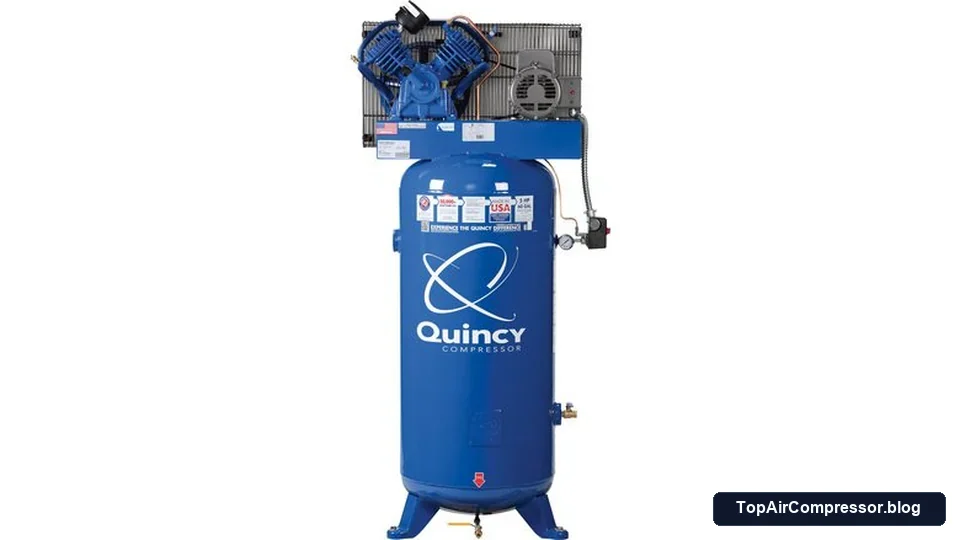
Heavy-duty air compressors rely on robust pump materials to withstand continuous industrial operation. The Quincy QT-54 utilizes a 100 percent cast-iron pump designed for extreme durability and reduced operating temperatures.
Ingersoll Rand approaches heavy-duty design by emphasizing high-efficiency valving and precision-balanced flywheels. Following our Ingersoll Rand pressure switch replacement guide helps technicians maintain proper electrical control and system reliability.
The Quincy QT-54 utilizes a heavy-duty solid cast iron crankcase and cylinder design designed for maximum rigidity. Conversely, Ingersoll Rand often incorporates modular aluminum components to shed weight and speed up initial manufacturing throughput.
Examining crankshaft metallurgy reveals distinct philosophies between these heavy-duty units. Quincy employs a balanced forged steel crankshaft supported by tapered roller bearings, while competing Ingersoll Rand models frequently use ductile iron shafts with standard ball bearings.
- Solid cast-iron crankcases
- Precision-machined cylinder walls
- Heavy-duty steel connecting rods
Material Metallurgy Comparisons
Evaluating the specific metallurgy reveals distinct manufacturing philosophies between both legacy brands. Quincy focuses on thick-walled castings to absorb vibration and lower overall mechanical noise.
Ingersoll Rand prioritizes aerodynamic cooling fins and optimized air-flow pathways across the pump head. This design philosophy reduces thermal distortion during extended high-pressure compression cycles.
- Quincy wall thickness
- Ingersoll cooling efficiency
Performance Output and CFM Delivery Mechanics
Delivering consistent cubic feet per minute is critical for running heavy pneumatic tools simultaneously. The Quincy QT-54 delivers robust CFM output at lower rotational speeds for extended service life.
Ingersoll Rand compressors deliver strong volumetric efficiency through optimized valve designs. Following our check valve replacement guide helps maintain correct tank pressure and prevents internal air leaks.
Volumetric efficiency dictates how effectively a two-stage compressor delivers compressed air at higher pressures. The QT series optimizes valve placement to reduce head dead space, boosting overall CFM per horsepower metrics during continuous high-demand shop applications.
Ingersoll Rand counters with aggressive stroke configurations that prioritize high ultimate pressure ratings. However, matching exact tank recovery times requires analyzing your specific pneumatic tool consumption profiles against published displacement curves under actual load conditions.
- High volumetric efficiency
- Reliable pressure recovery
- Consistent tool performance
Pressure Ratios and Tank Fill Times
Tank fill times directly impact daily workflow efficiency in busy commercial repair facilities. The QT-54 fills standard horizontal ASME tanks smoothly while maintaining stable discharge temperatures.
Ingersoll Rand engineering emphasizes fast recovery times to prevent workflow bottlenecks during continuous sanding. Operators working with high-demand sandblasters notice immediate pressure recovery benefits.
- Standard horizontal ASME tanks
- Rapid pressure recovery
Thermal Management and Duty Cycle Limits
Managing internal heat generation dictates how long industrial compressors can run before requiring cooldown intervals. Quincy incorporates intercoolers and finned copper tubing to dissipate thermal energy effectively.
Ingersoll Rand units utilize centrifugal unloader systems and high-velocity flywheel fans. Reviewing our Ingersoll Rand switch guide ensures proper electrical setup during heavy-duty thermal management cycles.
Managing compression heat prevents premature oil breakdown and catastrophic valve carbonization. Quincy implements deep-finned interstage coolers and copper-fin aftercoolers, dropping discharge temperatures significantly before air enters the primary ASME receiver tank.
Ingersoll Rand relies on centrifugal fan flywheels to force ambient air across the cylinder heads. While effective for standard duty cycles, heavy industrial environments demand stringent adherence to 80/20 duty ratios to prevent thermal overload shutdowns.
- Finned copper intercoolers
- Centrifugal unloader mechanisms
- Forced-air flywheel cooling
Continuous Duty Ratings
True continuous duty capabilities allow shops to operate pneumatic equipment without thermal shutdowns. Both manufacturers engineer these heavy stationary platforms for demanding multi-shift industrial facilities.
Monitoring oil temperatures helps operators maximize pump longevity and prevent catastrophic failure. Proper maintenance ensures thermal efficiency remains stable throughout the multi-year service lifespan.
- Multi-shift industrial facilities
- Thermal efficiency monitoring
Maintenance Protocols and Component Longevity
Routine maintenance protects your capital investment and prevents unexpected downtime in production environments. Quincy recommends synthetic lubricants that extend oil change intervals significantly beyond conventional mineral oils.
Ingersoll Rand provides accessible service points for filter replacements and belt tension adjustments. Reviewing our pressure switch adjustment guide ensures your compressor cycles accurately under load.
Routine servicing directly influences the operating lifespan of reciprocating industrial air compressors. The Quincy unit features easily accessible splash lubrication troughs, whereas Ingersoll Rand requires strict adherence to proprietary synthetic lubricant replacement schedules to maintain valid warranties.
Filter maintenance is another critical variable for daily shop efficiency. Inspecting intake elements weekly prevents abrasive particulate ingestion, ensuring your reed valves remain sealed tightly against carbon deposits throughout years of rigorous commercial service.
- Synthetic lubricant requirements
- Accessible oil sight glasses
- Simple filter change procedures
Consumables and Spare Parts Availability
Sourcing replacement air filters and pump oil should be straightforward for maintenance personnel. Both brands maintain extensive distributor networks across North America for rapid parts delivery.
Routine belt inspections prevent sudden slippage and maintain optimal pump speeds during peak loads. Establishing a structured preventative maintenance schedule guarantees maximum equipment uptime.
- Extensive distributor networks
- Routine belt inspections
Noise Emissions and Vibration Suppression
Workshop noise levels directly impact worker comfort and long-term hearing safety in enclosed facilities. The low-RPM design of the Quincy QT-54 results in significantly reduced decibel output compared to high-speed pumps.
Ingersoll Rand incorporates balanced crankshafts and vibration isolation pads to minimize mechanical shaking. Proper floor anchoring further dampens operational noise in professional automotive service centers.
Acoustic output directly impacts technician fatigue and workshop communication clarity. Cast iron construction naturally dampens mechanical harmonics, making the Quincy notably quieter than units built with thinner aluminum crankcases that tend to ring audibly.
Isolating reciprocating mass requires robust dampening pads bolted securely to reinforced concrete foundations. Proper installation prevents resonant floor vibrations from traveling across your facility, protecting sensitive pressure switches from premature structural fatigue damage.
- Lower operating RPM
- Balanced crankshaft assemblies
- Vibration isolation mounting
Acoustic Engineering Differences
Acoustic mitigation strategies vary depending on the specific pump displacement and motor horsepower. Quincy relies on slower pump speeds to naturally lower harsh mechanical frequencies.
Ingersoll Rand utilizes advanced intake silencers and muffled air filters to control high-frequency noise. Operators working nearby notice a softer, more manageable sound profile during compression.
- Advanced intake silencers
- Lower mechanical frequencies
Power Demands and Electrical Infrastructure
Supplying adequate electrical amperage is essential for safe, reliable stationary compressor installation. The Quincy QT-54 demands a robust three-phase electrical supply to handle heavy starting loads efficiently.
Ingersoll Rand offers versatile motor configurations suitable for various industrial and agricultural electrical grids. Verifying local voltage requirements before installation prevents costly electrical contractor callbacks.
Supplying reliable amperage to a five-horsepower motor demands careful electrical planning. Always verify your breaker sizing and wire gauge comply with national codes to prevent voltage drop during motor startup surges under heavy load.
Magnetic motor starters provide essential thermal overload protection for these heavy-duty industrial compressors. Integrating a fused disconnect switch near the tank safeguards your facility's wiring against unexpected short circuit failures during peak operating hours.
- Three-phase power compatibility
- Magnetic starter protection
- Dedicated circuit requirements
Electrical Safety and Control Panels
Industrial compressors require proper overload protection to prevent motor burnout during voltage fluctuations. High-quality magnetic starters safeguard internal windings against excessive current draw.
Professional installation by certified electricians ensures compliance with local electrical codes and safety standards. Proper wiring thickness eliminates voltage drop during heavy motor startup sequences.
- Overload protection
- Certified electrical installation
Selecting the Ideal Unit for Your Shop
Choosing the correct reciprocating compressor depends entirely on your daily air consumption volume. Facilities prioritizing maximum pump lifespan and lower operating temperatures should select the Quincy QT-54.
Operations requiring rapid parts availability and quick recovery cycles benefit immensely from Ingersoll Rand platforms. Assess your peak CFM requirements carefully before making a final purchasing decision.
Choosing the right compressor depends heavily on your daily air tool demands and expansion plans. If your facility runs sandblasters or dual-action sanders continuously, prioritizing maximum continuous CFM output outweighs initial equipment cost considerations.
Evaluate your local service dealer network before finalizing any compressor purchase decision. Having rapid access to genuine replacement parts minimizes costly operational downtime, ensuring your shop remains productive through every unexpected mechanical maintenance event.
- Evaluate daily CFM demand
- Assess electrical infrastructure
- Consider operating environment
Final Purchasing Considerations
Long-term operational costs include electricity, routine filter replacements, and scheduled oil changes. Investing in industrial-grade equipment minimizes unexpected repair expenses over the compressor lifespan.
Consult with equipment specialists to verify that your chosen model matches shop demands. Proper sizing prevents short-cycling and extends the functional life of your compressed air system.
- Long-term operational costs
- Proper system sizing
Frequently Asked Questions
Which compressor offers a longer operating lifespan for heavy commercial use?
The Quincy QT-54 provides a longer lifespan due to its slower pump RPM and heavy cast-iron construction. This design significantly reduces internal wear during multi-shift applications.
Can these industrial air compressors run on standard single-phase residential power?
Most heavy-duty models in this class require a dedicated three-phase electrical supply to operate safely. Always consult a certified electrician to verify your power capabilities before purchasing.
How often should I change the synthetic pump oil in these units?
Synthetic lubricants typically last between two thousand and four thousand operating hours depending on conditions. Regularly checking oil levels prevents premature pump failure and maintains optimal performance.
Which brand operates with less noise inside an enclosed workshop?
The Quincy QT-54 runs quieter because its slower rotational speed produces less mechanical vibration. Proper installation on isolation pads further minimizes ambient noise levels in your shop.
Are replacement parts easily accessible for both Quincy and Ingersoll Rand?
Both manufacturers maintain extensive distributor networks across North America for rapid component delivery. This widespread support ensures minimal downtime when routine maintenance or repairs become necessary.