Quincy vs. Ingersoll Rand Air Compressor: Which Fits Your Setup Better?
Choosing between Quincy and Ingersoll Rand requires analyzing industrial duty cycles and pump construction. This technical guide compares their heavy-duty air compressors across critical engineering metrics.


Choose Quincy for continuous-duty industrial applications requiring maximum pressure output. Select Ingersoll Rand when you need versatile mid-range pneumatic power with global service accessibility.
Compare all top models in our Best Air Compressor: Top Picks for Every Garage & Roadside.
Side-by-Side Breakdown
| Criteria | Quincy | Ingersoll Rand Air Compressor | Edge |
|---|---|---|---|
| Peak Performance & Output | High volumetric efficiency at max pressure | Exceptional mid-range displacement | Quincy |
| Duty Cycle & Consistency | 100% continuous duty on industrial tiers | Robust intermittent to continuous ratings | Quincy |
| Operating Noise & Vibration | Massive cast iron dampens vibration | Enclosed cabinets suppress noise well | Ingersoll Rand |
| Portability & Footprint | Heavy stationary industrial profiles | Versatile mobile and stationary builds | Ingersoll Rand |
| Maintenance & Service Life | Pro-grade synthetic longevity focus | Widespread parts availability and kits | Quincy |
| Power Requirements | Heavy-duty industrial motor integration | Optimized induction motors for efficiency | Tie |
| Best Ideal Use-Case | Heavy manufacturing and production lines | Automotive shops and general contracting | Tie |
Pump Construction and Metallurgy
Quincy compressors frequently employ heavy cast iron cylinders designed to maximize structural rigidity. This metallurgical choice drastically reduces thermal distortion under continuous industrial workloads.
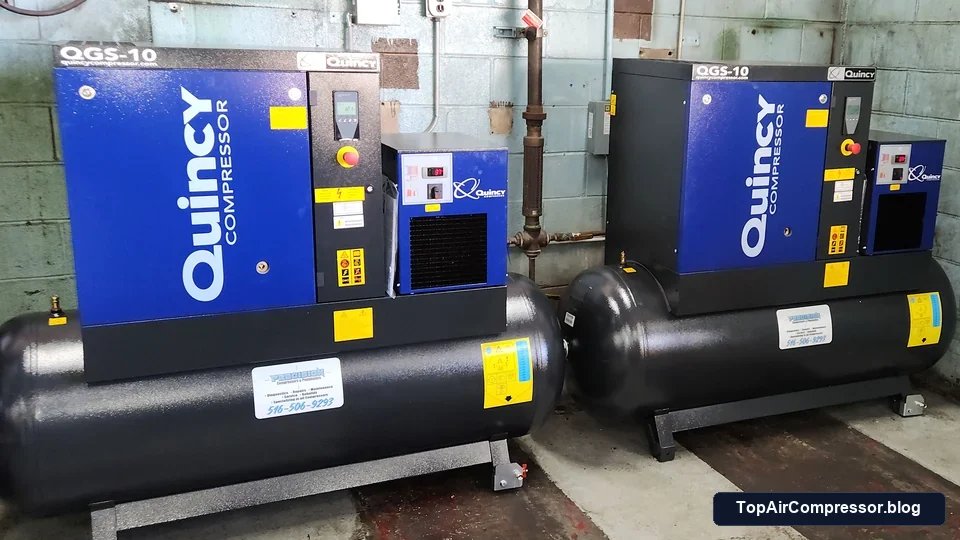
Ingersoll Rand utilizes precision-engineered aluminum and cast iron configurations depending on the specific tier. Their baseline pumps prioritize rapid heat dissipation over sheer mass.
Quincy compressors frequently employ cast iron crankcases and solid steel crankshafts to maximize structural rigidity. This metallurgical choice dampens harmonic resonance while enduring continuous industrial shift rotations without premature fatigue cracking.
Ingersoll Rand counters with precision-machined aluminum heads featuring deep cooling fins to shed heat rapidly. Their balanced ductile iron pistons reduce reciprocating mass, though heavy fabrication shops often favor Quincy's heavier thermal mass.
- Cast iron sleeves for durability
- Aluminum heads for thermal transfer
- Balanced crankshafts for smooth rotation
Stationary Industrial Metallurgy
Heavy-duty stationary units from Quincy feature splash or pressure lubrication systems tailored for extended runtimes. Ingersoll Rand matches this reliability, benefiting greatly from a properly tuned pressure switch replacement guide for accurate cycling.
- Pressure lubrication systems
- Splash lubrication backups
Volumetric Efficiency and CFM Output
Evaluating cubic feet per minute ratings demands close inspection of pressure drops. Quincy models often maintain higher volumetric efficiency at maximum pressure thresholds.
Ingersoll Rand delivers exceptional mid-range displacement, ensuring stable pneumatic tool performance across general automotive shops when using proper synthetic fluids detailed in our Ingersoll Rand oil selection guide.
Volumetric efficiency dictates how effectively a piston compresses ambient air versus displacement volume. Quincy units utilize ported valve plates that minimize clearance volume, ensuring higher delivered CFM per horsepower at rated working pressures.
Ingersoll Rand optimizes airflow dynamics through multi-stage intercooling configurations and streamlined manifold paths. Their engineering focus achieves competitive cubic feet per minute delivery, particularly under fluctuating demand loads typical in automotive service bays.
- High CFM delivery consistency
- Optimized valve plate designs
- Minimal pressure drop under load
Multi-Stage Compressor Dynamics
Two-stage configurations from both brands significantly boost overall pneumatic output. Quincy units frequently leverage lower RPM profiles to achieve equivalent displacement.
- Two-stage compression cycles
- Lower RPM operational profiles
Thermal Management and Duty Cycles
Effective thermal management dictates whether a compressor can sustain a hundred percent duty cycle. Quincy engineering excels at maintaining low operating temperatures.
Ingersoll Rand incorporates deep-fin cylinder heads and intercoolers to dissipate ambient heat rapidly during heavy-load cycles.
Excessive operating temperatures degrade synthetic compressor lubricants and accelerate valve carbonization. Quincy systems rely on massive cast iron cylinders that act as massive heat sinks, supporting a reliable 100 percent continuous duty cycle.
Ingersoll Rand utilizes centrifugal flywheel fan designs and features detailed troubleshooting steps in our Ingersoll Rand air compressor switch guide to prevent thermal shutdown during demanding peak production cycles in manufacturing facilities.
- Finned copper tubing layouts
- Advanced intercooler efficiency
- Extended duty cycle ratings
Ambient Temperature Resilience
Industrial environments require units that handle high ambient heat without tripping thermal overloads. Both manufacturers integrate safety switches to prevent catastrophic motor failure.
- Thermal overload protection
- High ambient heat tolerance
Operating Noise and Vibration Control
Acoustic output remains a major factor in shared workshop spaces. Ingersoll Rand often utilizes enclosed cabinet designs to suppress unwanted mechanical noise.
Quincy relies on massive cast iron crankcases and balanced flywheels to naturally dampen harmful vibrational frequencies at the source.
Shop floor acoustics dictate worker comfort and regulatory compliance regarding daily noise exposure limits. Quincy units feature dynamically balanced flywheels that minimize mechanical vibration, reducing decibel output significantly across heavy-duty industrial environments.
Ingersoll Rand incorporates proprietary isolation mounts and tuned intake silencers to attenuate harsh high-frequency whines. Their holistic approach targets structural harmonics, yielding a smoother acoustic profile suitable for shared commercial facilities.
- Sound-attenuating cabinet enclosures
- Dynamically balanced flywheels
- Vibration isolation mounting pads
Dynamic Balancing Standards
Minimizing vibration extends the operational lifespan of internal valves and external piping connections. Precision balancing ensures smooth operation across all RPM bands.
- Reduced pipe fatigue
- Smooth multi-band RPM output
Electrical Demands and Motor Integration
Industrial compressors demand strict compliance with electrical standards to avoid premature motor burnout. Quincy units often feature heavy-duty industrial-grade motors.
Ingersoll Rand utilizes highly efficient induction motors designed to reduce startup amperage spikes and optimize overall electrical consumption.
Industrial compressors demand robust electrical infrastructure to handle high startup torque requirements. Quincy partners with premium efficiency motors featuring TEFC enclosures to protect windings from abrasive dust and workshop humidity during operation.
Ingersoll Rand utilizes commercial-grade magnetic starters and thermal overload relays to safeguard electrical circuits. Proper sizing of full-load amperage parameters remains critical to prevent voltage sag and premature motor winding insulation breakdown.
- High starting torque ratings
- Controlled amperage draw profiles
- TEFC motor enclosure options
Voltage Options and Wiring
Facilities must verify single-phase versus three-phase availability before installation. Both brands offer versatile wiring options for diverse commercial settings.
- Single-phase configurations
- Three-phase commercial wiring
Maintenance Protocols and Service Life
Routine maintenance protects your capital investment in pneumatic infrastructure. Quincy recommends proprietary synthetic lubricants to extend valve service intervals.
Ingersoll Rand provides extensive parts availability and standardized filter kits, making routine preventative maintenance straightforward for internal technicians.
Routine maintenance schedules directly influence the operational lifespan of reciprocating and rotary screw compressors. Quincy emphasizes extended oil change intervals when utilizing synthetic lubricants, lowering overall consumable expenditures over decades of service.
Ingersoll Rand structures serviceability around easily accessible spin-on filters and clear sight glasses. Technicians appreciate simplified valve maintenance kits that reduce downtime during scheduled preventive maintenance interventions in busy facilities.
- Proprietary synthetic lubricants
- Standardized filter replacement kits
- Accessible internal valve assemblies
Long-Term Rebuild Potential
Cast iron pumps from both manufacturers can be easily bored and rebuilt multiple times. This capability ensures decades of reliable service.
- Boreable cast iron cylinders
- Extensive rebuild kits available
Application Engineering and Best Fit
Selecting the right brand depends entirely on your daily air consumption profile and duty requirements. Heavy production facilities lean toward Quincy.
General automotive repair shops and commercial construction contractors frequently benefit from the highly versatile pneumatic lineup offered by Ingersoll Rand.
Selecting the ideal compressor requires matching duty requirements with specific pneumatic tool consumption rates. Quincy excels in heavy manufacturing environments demanding uninterrupted air supply, where rugged build quality offsets higher initial capital investment costs.
Ingersoll Rand serves as a versatile solution for automotive repair shops, especially when following our Ingersoll Rand oil change guide to maintain optimal lubrication efficiency under heavy cyclical loads.
- Continuous industrial production lines
- Fast-paced automotive repair shops
- Jobsite contractor pneumatic rigs
Custom Installation Planning
Consulting with a certified mechanical engineer ensures proper tank sizing, piping layout, and pressure regulation for your specific workflow.
- Accurate CFM requirement matching
- Proper receiver tank sizing
Frequently Asked Questions
Which brand offers better pump longevity for heavy industrial facilities?
When evaluating pump longevity between these two industry giants, Quincy generally utilizes thicker cast iron components designed specifically for demanding continuous-duty industrial manufacturing applications.
Quincy units typically provide an exceptional operational lifespan when maintained properly with approved synthetic lubricants according to strict factory maintenance schedules.
How do parts availability and servicing compare between the two?
Ingersoll Rand models often excel in demanding environments where you need widespread service network accessibility and readily available replacement parts for routine maintenance tasks.
Ingersoll Rand compressors provide outstanding versatility across a wide range of automotive and general contracting applications without sacrificing overall mechanical reliability.
Should I choose a single-stage or two-stage pump setup?
Deciding between single-stage and two-stage configurations depends heavily on your peak pressure requirements and daily air consumption volume measured in cubic feet per minute. Two-stage compressors from both manufacturers deliver significantly higher operating pressures necessary for demanding heavy pneumatic tools.
What electrical considerations matter most for these heavy compressors?
Proper electrical planning is critical because heavy industrial air compressors draw substantial amperage during initial motor startup sequences across all operational phases.
Three-phase electrical service is almost always recommended for larger stationary models to ensure stable voltage delivery and prevent premature motor failure.
What routine maintenance is required to keep them running efficiently?
Routine maintenance schedules require checking oil levels daily, changing synthetic compressor oil annually, and thoroughly inspecting intake air filters every single month. Preventative maintenance remains the single most effective method for significantly extending the operational life of your pneumatic equipment.