Rapidair vs. Copper Air Lines: Which Fits Your Setup Better?
Choosing between Rapidair polymer tubing and traditional copper pipes involves balancing installation speed against long-term rigidity. Engineers must evaluate pressure drops, thermal expansion coefficients, and workshop layouts carefully.


Rapidair wins for rapid, DIY workshop installations requiring flexible routing and minimal corrosion risks. Copper air lines remain the gold standard for permanent, high-flow industrial facilities demanding absolute rigidity.
Compare all top models in our Best Air Compressor: Top Picks for Every Garage & Roadside.
Side-by-Side Breakdown
| Criteria | Rapidair | Copper Air Lines | Edge |
|---|---|---|---|
| Peak Performance & Output | Moderate to high flow | Maximum unrestricted flow | Copper Air Lines |
| Duty Cycle & Consistency | Stable under standard loads | Exceptional continuous capacity | Copper Air Lines |
| Operating Noise & Vibration | Absorbs mechanical shock well | Transmits vibration rigidly | Rapidair |
| Portability & Footprint | Lightweight modular routing | Fixed heavy infrastructure | Rapidair |
| Maintenance & Service Life | Easy modular modifications | Requires soldered repairs | Rapidair |
| Power Requirements | Compatible with standard compressors | Handles massive industrial outputs | Copper Air Lines |
| Best Ideal Use-Case | Garages and custom workshops | Large manufacturing plants | Split |
Material Composition and Engineering Standards
Rapidair utilizes extruded aluminum or high-density multilayer polymer tubing engineered for compressed air applications. This specialized composite prevents rust flakes from contaminating sensitive pneumatic tools downstream during continuous cycles.
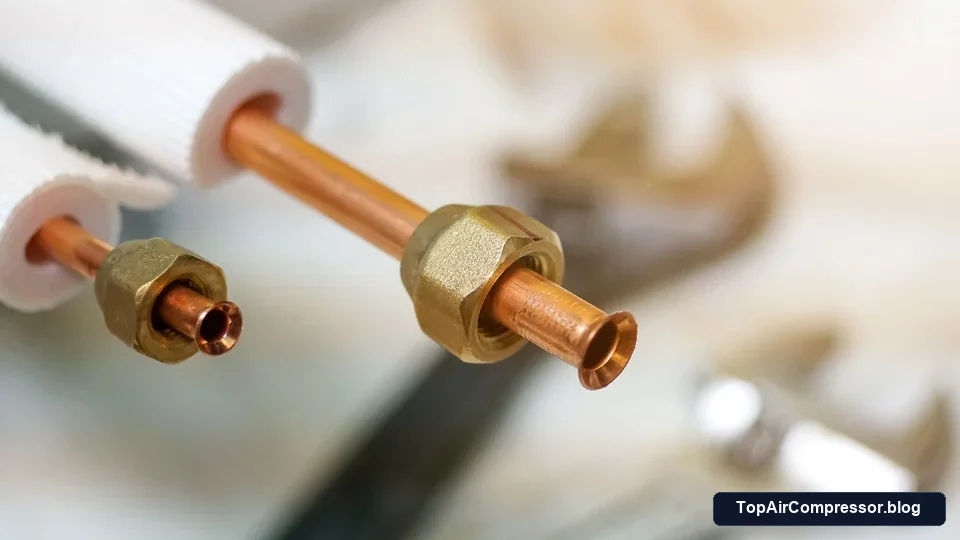
Copper air lines employ drawn copper tubing joined via soldered fittings. Checking our best air compressor to blow out rv water lines guide ensures such metallic construction offers zero permeability for industrial environments.
Evaluating these distinct material profiles dictates how your pneumatic network handles everyday moisture and pressure fluctuations. Selecting the proper foundation prevents catastrophic line failures in high-demand production environments.
- Rapidair tubing resists oil carryover and compressor varnish effectively.
- Copper piping provides an impervious barrier against ambient atmospheric moisture.
- Both materials meet ASME standards for compressed air distribution safety.
Polymer Engineering and Multilayer Construction
Modern polymer composites combine aluminum layers with inner polyethylene linings to eliminate micro-leaks. This bonded sandwich construction delivers superior strength while maintaining lightweight handling characteristics across expansive workshop ceilings.
Engineers appreciate how these flexible composite tubes absorb mechanical vibration from reciprocating compressors. Such dampening reduces stress concentrations at threaded connection points throughout the entire distribution network.
- Aluminum core eliminates pipe sagging between ceiling hangers.
- Smooth inner walls minimize turbulent boundary layer friction.
Metallic Metallurgy and Drawn Copper Tubing
Drawn copper tubes undergo rigorous manufacturing processes to achieve uniform wall thickness and concentricity. This metallurgical precision guarantees high burst ratings when handling heavy-duty industrial compressor outputs.
Rigid copper installations require careful selection of temper grades, typically utilizing hard-drawn straight lengths for main headers. Proper alloy selection prevents premature fatigue cracking near high-vibration compressor discharge ports.
- Hard temper copper resists sagging over long unsupported spans.
- Flame-joined fittings create permanent, leak-free molecular bonds.
Pressure Drop Dynamics and Flow Efficiency
Minimizing friction loss across your distribution network ensures pneumatic tools operate at peak rated CFM. Rapidair features smooth interior walls that restrict pressure drops over moderate workshop distances quite effectively.
Copper offers exceptionally low friction coefficients due to its polished interior surface finish. This superior inner smoothness maximizes volumetric flow, making copper ideal for long runs in large facilities.
Calculating equivalent length of fittings helps engineers design balanced headers regardless of pipe material. Proper sizing guarantees consistent tool performance at the furthest drop from the primary air receiver.
- Rapidair push-to-connect fittings maintain wide internal flow diameters.
- Copper sweat fittings eliminate internal flow restrictions caused by threads.
- Proper pipe sizing prevents starvation in high-consumption air tools.
Analyzing Internal Friction Losses
Rough interior surfaces cause turbulent airflow, which robs your compressor of usable work energy. Following our best way to run air compressor lines guide reveals how polymer composites offer impressive flow efficiency.
As compressed air travels through piping networks, velocity changes create measurable pressure drops. Engineers must balance pipe diameter against total system CFM demands to maintain adequate pressure.
- Oversizing main headers reduces velocity-induced friction losses.
- Smooth transitions prevent localized pressure drops at elbows.
Optimizing Header Diameters for Peak CFM
Main header sizing dictates how many tools can operate simultaneously without pressure starvation. Upgrading to larger distribution diameters ensures stable pressure during heavy industrial production shifts.
Copper systems allow precise sizing increments using standard commercial tubing diameters. This dimensional accuracy helps facilities fine-tune airflow velocities to match specific compressor output ratings.
- Main trunk lines should exceed drop line diameters by one size.
- Consistent sizing prevents pressure spikes during compressor cycling.
Installation Labor and Mechanical Assembly
Time is money during workshop build-outs, making installation speed a critical project metric. Rapidair kits use simple mounting hardware and push-to-connect fittings that cut installation hours down drastically.
Installing copper lines demands specialized plumbing skills, including pipe cutting, deburring, fluxing, and torch soldering. This labor-intensive process requires certified technicians to ensure joints withstand high pneumatic pressures safely.
Evaluating total installed cost must account for specialized labor versus simple DIY assembly kits. Choosing the right installation method directly impacts your initial capital expenditure and project timeline.
- Rapidair kits include mounting brackets, blocks, and tubing cutter tools.
- Copper installation requires propane torches, flux, and lead-free solder.
- Modular systems allow future layout expansions without specialized plumbing tools.
Modular Push-to-Connect Systems
Push-to-connect technology allows technicians to assemble complex pneumatic loops without threading pipes. O-ring seal designs lock tubing securely while providing instant disassembly when workshop layouts change.
Eliminating the need for pipe thread sealant prevents particulate contamination inside the air stream. Clean mechanical assembly safeguards sensitive pneumatic cylinders and automated production machinery from debris.
- Double O-ring seals ensure redundant leak protection.
- Locking collets grip aluminum tubing securely under load.
Traditional Soldering and Brazing Techniques
Sweating copper pipes demands precise heat control to draw solder completely into joints. Proper capillary action creates bonded joints capable of withstanding hundreds of pounds of working pressure.
Safety protocols during copper installation require fire watches and proper workspace ventilation. Professional brazing eliminates potential weak points in permanent, high-temperature industrial compressor rooms.
- Silver solder provides superior tensile strength over soft solder.
- Thorough flux cleaning prevents internal pipe corrosion.
Durability, Corrosion and Environmental Tolerance
Compressed air naturally contains moisture that triggers internal oxidation in vulnerable piping materials. Rapidair polymer and aluminum construction resists rust, keeping delivered air completely free of metallic particulate contaminants.
Copper naturally forms a protective patina but remains susceptible to certain chemical environments and erosion. High-velocity moisture laden air can cause impingement, eventually thinning copper walls at sharp bends.
Assessing environmental exposure helps determine which material survives harsh workshop conditions reliably. Protecting lines from physical impact and UV radiation extends the operational lifespan of your infrastructure.
- Aluminum outer layers protect internal polymer walls from UV damage.
- Copper resists degradation from synthetic compressor lubricants.
- Corrosion-resistant lines prevent premature pneumatic tool wear.
Preventing Condensation and Rust Contamination
Water vapor condensation inside unlined steel piping causes severe internal corrosion. Reviewing the best air compressors for blowing out water lines ensures you select equipment that prevents residual moisture accumulation effectively.
Installing downstream air dryers significantly reduces moisture loading across both distribution networks. Dry air preserves internal pipe integrity regardless of whether you choose polymer or copper.
- Internal moisture separators protect drop manifold outlets.
- Corrosion-free walls maintain smooth laminar airflow indefinitely.
Handling Chemical Exposure and Workshop Hazards
Automotive and industrial shops frequently expose air lines to solvents, oils, and physical impacts. Rapidair exterior jackets withstand chemical overspray, though direct physical strikes can dent exposed runs.
Rigid copper lines withstand physical abuse better but require careful placement away from forklifts. Protecting low wall drops with steel guards prevents accidental crushing in busy manufacturing facilities.
- Chemical resistance prevents material embrittlement over time.
- Physical guards protect vulnerable wall drops from machinery.
Thermal Expansion and Dimensional Stability
Temperature swings in unconditioned workshops cause metal and plastic pipes to expand and contract. Copper exhibits low thermal expansion coefficients, maintaining straight alignment across long seasonal temperature shifts.
Polymer tubing expands more than metal under rising ambient shop temperatures and friction heat. Engineers must incorporate expansion loops or sliding brackets to prevent buckling along long ceiling runs.
Proper structural support design accommodates natural thermal movement without placing undue stress on fittings. Accounting for dimensional changes prevents joint separation during extreme seasonal weather variations.
- Copper requires fewer expansion compensators in straight runs.
- Polymer systems need slip brackets to accommodate thermal movement.
- Ceiling hangers must allow smooth longitudinal tube sliding.
Calculating Thermal Movement in Polymers
Polymer composites respond dynamically to ambient temperature shifts within industrial workshops. Accounting for linear expansion rates prevents unsightly sagging between fixed ceiling support brackets.
Using flexible drop connections absorbs cumulative thermal growth across expansive system layouts. Smart engineering ensures reliable sealing performance despite continuous thermal cycling.
- Linear expansion must be calculated per 100 feet of run.
- Flexible offsets neutralize thermal stress at wall corners.
Rigidity and Thermal Stability in Copper
Copper maintains structural rigidity across wide temperature ranges without sagging noticeably. Its low thermal expansion rate keeps pipe runs perfectly aligned against workshop walls and beams.
Rigid metallic installations still require expansion loops when routing between distinct temperature zones. Proper anchoring controls movement direction, protecting soldered joints from cyclic fatigue.
- Rigid mounting brackets prevent vibration-induced sagging.
- Temperature swings have minimal impact on copper geometry.
Maintenance Protocols and System Modification
Workshops evolve continuously, requiring periodic additions of new drop lines and regulators. Rapidair modular systems simplify modifications, allowing technicians to tap into existing lines quickly without special tools.
Modifying rigid copper piping requires draining the system, cutting pipes, and resoldering joints. This maintenance downtime disrupts production schedules, making future expansions more costly and time-consuming.
Evaluating long-term flexibility ensures your compressed air infrastructure adapts easily to changing facility needs. Modular designs reduce lifecycle modification costs significantly compared to rigid metal piping.
- Rapidair allows adding new drop outlets in minutes.
- Copper modifications require complete system depressurization and drying.
- Modular blocks simplify regulator and filter relocations.
Expanding and Reconfiguring Polymer Networks
Adding a new workstation drop with Rapidair requires simply cutting the tube and inserting a tee block. This tool-free expansion capability minimizes downtime during busy manufacturing periods.
Reusable fittings allow technicians to reconfigure entire workshop layouts during facility remodels. Modular components salvage easily, reducing material waste when upgrading system capacity.
- Push-to-connect tees make branch additions effortless.
- System layout changes require minimal labor hours.
Servicing and Repairing Copper Networks
Repairing a damaged copper line demands purging residual air and thoroughly drying the interior. Torch soldering in tight spaces requires experienced personnel and strict fire safety precautions.
Permanent copper repairs offer exceptional long-term reliability once completed by professional plumbers. Proper maintenance ensures decades of trouble-free service in demanding industrial compressor rooms.
- Damaged sections require tubing cutters and replacement splices.
- Professional brazing guarantees permanent structural integrity.
Total Cost Analysis and Lifecycle Value
Initial material expenses represent only part of your compressed air infrastructure investment. Rapidair delivers lower total installed costs due to minimal labor requirements and DIY-friendly assembly kits.
Copper air lines involve higher upfront material costs and professional labor expenses. Reviewing how to blow out sprinkler lines with an air compressor shows that their exceptional multi-decade lifespan provides outstanding long-term value.
Balancing upfront budget constraints against long-term operational goals guides optimal material selection. Investing in quality distribution piping protects downstream tools and minimizes costly production downtime.
- Rapidair kits reduce initial labor overhead significantly.
- Copper piping offers unmatched multi-decade durability.
- Properly sized lines lower compressor energy consumption.
Evaluating Upfront Capital Expenditures
Budget-conscious shop owners appreciate complete packaged piping kits that eliminate guesswork. Rapidair provides economical entry points for growing businesses needing professional pneumatic distribution.
Copper installations demand significant upfront capital for premium materials and skilled labor. Facility planners must weigh initial expenses against expected operational longevity and maintenance savings.
- Packaged kits include all necessary mounting hardware.
- Copper requires professional plumbing tools and supplies.
Calculating Long-Term Operating Return
Eliminating air leaks preserves compressor duty cycles and lowers electrical energy bills. Efficient distribution systems pay for themselves over years of continuous workshop operation.
Choosing durable piping materials prevents premature replacement and unexpected facility disruptions. Reliable infrastructure protects your bottom line by ensuring consistent pneumatic tool performance.
- Leak-free fittings reduce unnecessary compressor run time.
- Durable materials eliminate recurring infrastructure replacement costs.
Frequently Asked Questions
Can I connect Rapidair polymer tubing directly to my compressor discharge?
Always install a flexible vibration hose between your compressor and hard piping. This vital buffer prevents heat and vibration from damaging your distribution network.
Is copper piping safe for high-pressure industrial compressor systems?
Type L and K copper handle high pressures exceptionally well when installed correctly. Properly soldered joints withstand extreme industrial loads without risking catastrophic structural failure.
How do I prevent moisture accumulation in my compressed air lines?
Install refrigerated air dryers and automatic tank drains upstream of your distribution headers. Proper condensate management protects your entire piping network from internal corrosion and moisture damage.
Can Rapidair tubing be painted to match workshop interior walls?
Painting polymer tubing is generally unnecessary and can degrade outer protective layers. Manufacturers recommend leaving lines unpainted to maintain warranty coverage and inspect for damage.
What is the best way to expand an existing copper air line system?
Expanding copper requires cutting the line, cleaning the pipe ends, and soldering new fittings. Professional plumbing expertise is essential to maintain safe pressure ratings during modifications.