Single Stage Compressor vs. Two Stage: Which Fits Your Setup Better?
Single stage compressors use one piston stroke to compress air, while two stage units compress air twice for higher pressures. Understanding these mechanical differences prevents costly equipment mismatches in industrial workshops.

Choose single stage for intermittent shop tasks and standard pneumatic nailers. Select two stage if your facility runs heavy industrial sandblasters demanding continuous 175 PSI output.
Compare all top models in our Best Air Compressor: Top Picks for Every Garage & Roadside.
Side-by-Side Breakdown
| Criteria | Single Stage Compressor | Two Stage | Edge |
|---|---|---|---|
| Peak Performance & Output | 125 to 135 PSI limit | 175 to 200 PSI capacity | Two Stage |
| Duty Cycle & Consistency | 50 percent maximum duty cycle | 100 percent continuous operation | Two Stage |
| Operating Noise & Vibration | Moderate vibration levels | Lower thermal stress, balanced pumps | Two Stage |
| Portability & Footprint | Compact, mobile configurations | Heavy vertical stationary tanks | Single Stage Compressor |
| Maintenance & Service Life | Simpler parts, higher heat wear | Robust cast-iron durability | Two Stage |
| Power Requirements | Standard 120V or 230V power | Dedicated 230V or 460V service | Single Stage Compressor |
| Best Ideal Use-Case | Automotive garages and framing | Manufacturing plants and body shops | Two Stage |
Fundamental Compression Mechanics and Pump Design
Single stage air compressors rely on a single piston cylinder to draw in ambient atmosphere and compress it directly into the storage tank. This straightforward mechanism delivers reliable pressure for standard pneumatic applications without complex valving.
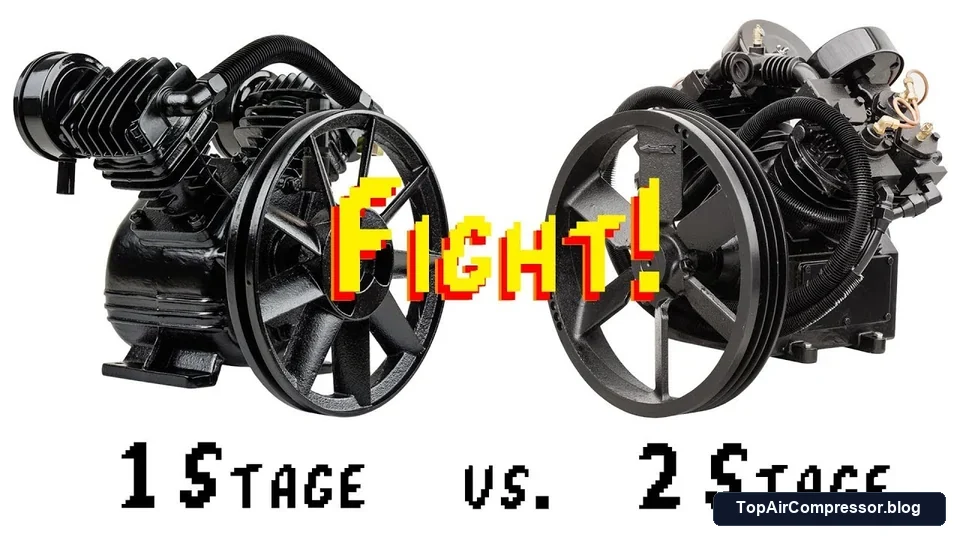
Two stage compressors incorporate a high-pressure piston and a low-pressure piston working in tandem. Ambient air enters the large low-pressure cylinder first, gets pre-compressed, passes through an intercooler, and finishes compression in the small cylinder.
When evaluating the best single stage air compressor units, pumps utilize one piston stroke to compress atmospheric air directly to storage pressure. This mechanical simplicity reduces acquisition costs while maintaining efficiency.
Conversely, two-stage units route air through an intercooler loop between cylinders. The first piston compresses the charge partially, while the secondary smaller piston delivers final high-pressure pneumatic output safely.
- Single stage uses one direct piston stroke into the tank.
- Two stage routes air through dual cylinders for staged pressure.
- Multi-stage pumps utilize internal intercoolers to drop operating temperatures.
Intercooler Engineering in Multi-Stage Units
The intermediate cooling tube situated between cylinders drops air temperature significantly before final compression. Lower intake temperatures inside the secondary cylinder drastically improve volumetric efficiency and reduce thermal stress on internal reed valves.
Without effective intercooling, multi-stage pumps would overheat rapidly under sustained industrial loads, leading to premature carbon buildup and catastrophic valve failure. Thermal management remains the defining advantage of advanced reciprocating pump architectures.
- Intercoolers lower air temperatures between compression stages.
- Advanced cooling protects delicate reed valves from heat degradation.
Performance Metrics and Pressure Output Capabilities
Single stage systems typically peak at maximum operating pressures around 125 to 135 PSI. This pressure ceiling easily satisfies general automotive service needs, paint spraying, and common assembly line air tools.
Two stage configurations effortlessly achieve continuous pressures reaching 175 to 200 PSI. That extended pressure margin provides the heavy reserve required for industrial die grinders, heavy sandblasters, and high-demand pneumatic stamping machines.
Standard single-stage compressors typically operate effectively up to 115 PSI maximum pressure, suiting general automotive repair shops. Continuous operation beyond this threshold causes accelerated ring wear and thermal overload.
Two-stage configurations easily achieve 175 PSI operating thresholds and higher cubic feet per minute delivery rates. This heavy-duty pneumatic capability supports demanding industrial sandblasters, large impact wrenches, and multi-user assembly lines.
- Single stage targets general shop pressure requirements.
- Two stage delivers high-pressure pneumatic capability.
- Extended pressure margins prevent tool starvation during heavy use.
Cubic Feet per Minute Delivery Analysis
Evaluating CFM delivery requires analyzing pump displacement against actual volumetric output at specific pressure thresholds. Two stage pumps maintain higher CFM delivery under heavy loads because double compression minimizes pressure drop.
- CFM output defines overall tool operating capability.
- Double compression maintains stable volumetric efficiency.
Thermal Dynamics and Pump Cooling Efficiency
Single stage pumps generate intense heat because all pressure generation happens in one rapid stroke. Without intercooling tubes, cylinder heads reach extreme temperatures, necessitating frequent cooling pauses during heavy shop utilization.
Two stage architecture inherently mitigates thermal overload through staged compression and cast-iron intercoolers. This design maintains lower operating temperatures, extending lubricant life and protecting vital piston rings from thermal degradation.
Compressing ambient air generates extreme heat that threatens internal component integrity. Single-stage systems rely entirely on flywheel fan blades to dissipate thermal energy across external cast iron cooling fins.
Upgrading to the best two stage air compressor models introduces intercoolers that drop air temperatures between compression stages. Lower operating temperatures prevent oil breakdown, significantly extending pump lifespan under heavy industrial loads.
- Single stage pumps experience high operating temperatures.
- Two stage designs dissipate heat efficiently across dual cylinders.
Oil Breakdown and Lubrication Management
Excessive heat in single stage compressors breaks down compressor oil rapidly, leading to varnish formation on valve plates. Maintaining proper oil viscosity is critical for preventing metal-on-metal wear in high-temperature single cylinder environments.
- High heat accelerates oil breakdown in single stage pumps.
- Proper lubrication safeguards internal components from scoring.
Duty Cycle Capabilities and Workload Demands
Most single stage units feature a 50 percent duty cycle, meaning the motor runs half the time and rests the other half. Exceeding this thermal threshold invites thermal overload trips and permanent motor winding damage.
Industrial two stage compressors often boast a 100 percent continuous duty cycle when paired with ASME vertical tanks. Facilities running multiple shifts rely on this continuous capability to prevent costly pneumatic line pressure drops.
Operating a single-stage machine requires adhering to a strict 50 percent duty cycle to prevent motor burnout. Exceeding this thermal threshold leads to catastrophic reed valve failure and expensive repairs.
Industrial two-stage units commonly deliver an 80 to 100 percent duty cycle for uninterrupted shift operations. Facilities running pneumatic tools continuously rely on this robust thermal endurance to prevent costly downtime.
- Single stage units require mandatory cooling rest intervals.
- Two stage compressors support continuous multi-shift operations.
Intermittent Shop Environments versus Continuous Plants
Commercial body shops with sporadic tool usage find single stage compressors perfectly adequate for daily tasks. Conversely, automated manufacturing assembly cells demand the unwavering uptime guaranteed by robust two stage industrial machinery.
- Intermittent work fits single stage operational limits.
- Industrial automation requires continuous-duty reliability.
Physical Footprint and Installation Requirements
Single stage compressors generally utilize horizontal layouts or smaller vertical tanks, fitting easily into cramped garage corners. Their lighter structural weight simplifies transport and reduces overall flooring reinforcement requirements during installation.
Two stage systems demand heavy-duty vertical ASME storage tanks and substantial concrete pad anchoring. Their massive cast-iron pumps and heavy electric motors create significant operating vibrations that require proper isolation pads.
Selecting the best 60 gallon single stage air compressor models provides compact vertical layouts optimized for limited floor space. Their lighter structural weight simplifies shop relocation and minimizes specialized concrete foundations.
Two-stage systems demand robust concrete anchoring due to heavy cast-iron pumps and extended vertical storage tanks. Proper installation requires sufficient clearance around cooling fins to ensure adequate ambient airflow circulation.
- Single stage units offer compact, movable footprints.
- Two stage compressors require permanent, reinforced concrete installation.
Weight and Rigging Considerations
Transporting a heavy two stage compressor requires specialized lifting equipment and pallet jacks due to top-heavy weight distribution. Proper floor loading calculations ensure facility safety when positioning large industrial vertical receivers.
- Heavy vertical tanks demand careful rigging during placement.
- Facility floors must support significant operating weight.
Maintenance Protocols and Component Lifespan
Single stage models feature fewer internal moving parts, simplifying routine belt inspections and air filter replacements. However, their higher operating temperatures often accelerate wear on reed valves and intake gaskets over time.
Two stage compressors require meticulous maintenance, including intercooler fin cleaning and frequent oil level checks. Despite complex plumbing, their heavy-duty cast-iron construction routinely delivers decades of reliable service under harsh industrial conditions.
Routine maintenance for single-stage equipment involves checking intake filters and draining accumulated moisture daily from receiver tanks. Synthetic compressor oil changes should occur every five hundred operating hours reliably.
Two-stage architectures require rigorous valve inspections alongside standard intercooler fin cleaning to maintain optimal thermal dissipation. Replacing worn piston rings promptly prevents pressure bypass and preserves factory volumetric efficiency.
- Single stage units offer simpler routine filter service.
- Two stage pumps deliver exceptional long-term cast-iron durability.
Valve Inspection and Carbon Removal
Inspecting stainless steel reed valves annually prevents unexpected air pressure losses in high-hour commercial workshops. Removing carbon deposits from discharge ports ensures peak volumetric efficiency and prevents dangerous valve overheating incidents.
- Annual valve checks prevent unexpected pressure drops.
- Carbon cleaning maintains peak volumetric pump efficiency.
Power Delivery and Electrical Infrastructure
Single stage units frequently operate on standard 120V or 230V single-phase power, plugging directly into common shop electrical outlets. This accessibility makes them ideal for mobile contractors and smaller independent automotive repair garages.
Choosing the best two stage air compressor for the money requires dedicated 230V or 460V three-phase electrical service to handle massive startup torque. Upgrading facility panels is often necessary before installation.
Most residential single-stage compressors operate efficiently on standard 120V or 240V circuits, minimizing expensive electrical upgrades. Always verify dedicated breaker amperage matches equipment nameplate specifications to prevent frequent tripping.
Heavy-duty two-stage systems demand robust three-phase electrical power configurations to handle high startup torque requirements. Professional electrician consultation is mandatory before installing these commercial-grade units in standard facilities.
- Single stage compressors plug into standard electrical outlets.
- Two stage units require heavy-duty industrial electrical wiring.
Starting Amperage and Motor Protection
Magnetic starters and thermal overload relays protect heavy two stage motors from damaging electrical spikes during startup phases. Proper wiring gauge selection prevents voltage drops that could otherwise ruin expensive industrial compressor motors.
- Magnetic starters protect motors from startup electrical surges.
- Correct wire sizing prevents harmful voltage drop incidents.
Frequently Asked Questions
Can I convert a single stage compressor into a two stage machine?
No, conversion is physically impossible due to mismatched piston bores, cylinder dimensions, and crankcase ratings. Purchasing a dedicated two stage unit remains the only viable engineering solution.
Why do two stage compressors run cooler than single stage models?
Splitting compression workload across two separate cylinders with an intercooler reduces heat buildup significantly. Lower operating temperatures protect compressor oil and internal components from thermal damage.
Do two stage compressors require three-phase electrical power?
Not always, as some heavy-duty residential units operate on single-phase 230V power. However, industrial-grade two stage systems almost universally require three-phase service for reliable motor startup.
What happens if a single stage compressor runs continuously?
Continuous running causes extreme overheating, rapid oil breakdown, and eventual thermal motor overload trips. This practice severely shortens compressor lifespan and voids manufacturer warranties.
Which compressor type offers better energy efficiency for large shops?
Two stage compressors provide superior volumetric efficiency at higher pressures, consuming fewer kilowatt-hours per CFM delivered. This efficiency advantage lowers long-term electricity bills in busy facilities.