Viair vs. Arb Air Compressor: Which Fits Your Setup Better?
Navigating mobile pneumatics requires weighing continuous delivery against targeted inflation speed. This technical breakdown evaluates Viair and ARB units for demanding field applications.

Choose Viair for budget-friendly modular portability, or select ARB for uncompromising twin-motor output and heavy-duty auxiliary air demands.
Compare all top models in our Best Air Compressor: Top Picks for Every Garage & Roadside.
Side-by-Side Breakdown
| Criteria | Viair | Arb Air Compressor | Edge |
|---|---|---|---|
| Peak Performance & Output | Moderate CFM with high pressure ratings | High twin-motor CFM delivery | Arb Air Compressor |
| Duty Cycle & Consistency | Varies from 30% to 100% by series | 100% duty cycle on twin models | Arb Air Compressor |
| Operating Noise & Vibration | Standard mechanical compressor drone | Engineered rubber damping mounts | Viair |
| Portability & Footprint | Extensive standalone portable kits | Optimized for permanent vehicle mounting | Viair |
| Maintenance & Service Life | Readily available replacement service parts | Sealed industrial-grade internal bearings | Arb Air Compressor |
| Power Requirements | Direct 12V battery clamp options | Heavy-gauge dedicated relay harnesses | Viair |
| Best Ideal Use-Case | Tire inflation and light lockers | Rapid locker actuation and air tools | Arb Air Compressor |
Engineering Architecture and Core Design Philosophy
Evaluating mobile pneumatic systems begins with understanding foundational manufacturing philosophies. Viair units prioritize modular standalone configurations designed for versatile universal deployment.
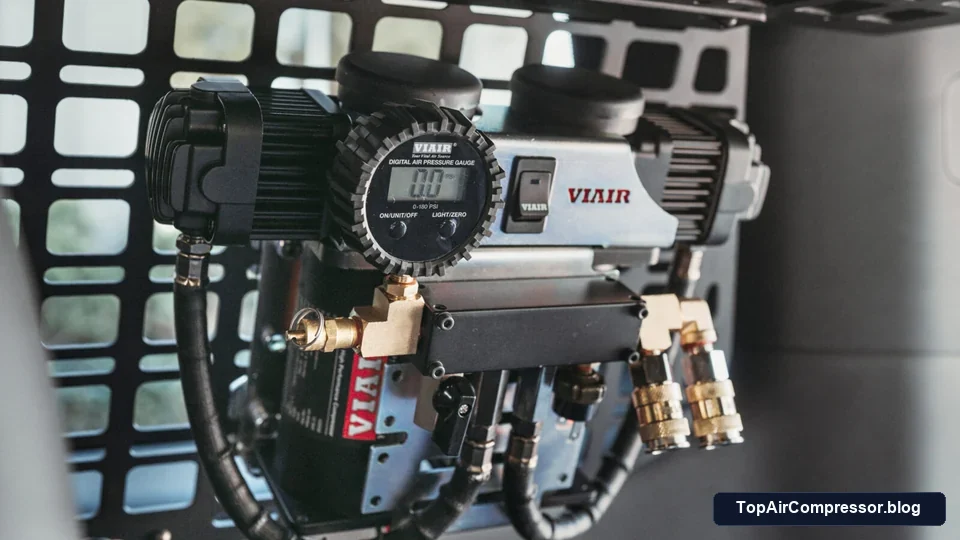
Conversely, ARB compressors focus heavily on integrated permanent installations inside harsh automotive engine bays. Their engineering targets direct differential locker actuation reliability above all else.
Material selection heavily dictates how each brand handles operational stress. Anodized cylinder walls reduce friction coefficients while dissipating thermal energy efficiently during extended cycles.
Viair units typically employ an oil-less direct-drive motor coupled to a PTFE piston ring, prioritizing lightweight portability and minimal mechanical complexity for mobile enthusiasts.
Conversely, as detailed in our ARB twin air compressor review, ARB relies on a permanent magnet motor driving a sealed ball-bearing crankshaft engineered for harsh under-hood environments.
Understanding these foundational design choices dictates your vehicle mounting locations, as Viair favors interior cabin or toolbox placement, whereas ARB targets dedicated engine bay brackets.
- Viair emphasizes portable standalone compressor kits.
- ARB prioritizes permanent under-hood vehicle mounting.
- Both utilize specialized oil-less piston rings.
Piston Stroke and Motor Geometries
Internal motor windings dictate longevity under sustained electrical loads. Copper-wound stators resist thermal degradation better than aluminum alternatives during heavy use.
Stroke lengths directly impact volumetric efficiency and output pressure curves. Longer strokes yield higher pressure ceilings while shorter strokes optimize raw flow volume.
- Stator material impacts heat resistance.
- Stroke geometry alters pressure capabilities.
Real-World Output, CFM Delivery, and Pressure Curves
Delivered cubic feet per minute dictates how fast large tires return to street pressure. Twin-cylinder setups double air displacement rates compared to single-cylinder variants.
Pressure thresholds determine compatibility with pneumatic tools and specialized lockers. Eighty psi cut-offs satisfy standard differential requirements without taxing electrical systems.
Monitoring pressure curves reveals performance drops as tank pressure increases. Efficient valve plates maintain consistent volumetric efficiency throughout the fill cycle.
Air delivery drops significantly as tank pressure climbs, meaning a unit rated high at zero PSI will experience a sharp volumetric efficiency decay near 100 PSI.
Viair compressors often maximize free flow at lower pressures, making them exceptionally fast for initial tire inflation tasks before the backpressure slows down the piston stroke.
Meanwhile, ARB maintains a flatter CFM delivery curve across mid-range operating windows, ensuring consistent pneumatic tool performance and rapid locker actuation under demanding operational cycles.
- Twin cylinders maximize raw air volume.
- Pressure thresholds dictate tool compatibility.
- Valve plate design prevents backflow losses.
Inflation Speed Testing Metrics
Filling thirty-five-inch tires demands sustained thermal endurance and high airflow. Rapid recovery times minimize engine idling durations out on the trail.
Pressure drop testing highlights manifold restriction points during high-demand operations. Smooth internal passages prevent turbulent flow losses across fittings.
- Tire size influences recovery requirements.
- Manifold design reduces turbulent flow.
Thermal Management, Duty Cycles, and Continuous Run Limits
Heat remains the primary enemy of mobile electric motor-driven compressors. Integrated cooling fins machined into aluminum heads dissipate combustion-less thermal buildup rapidly.
Duty cycle ratings dictate safe operating intervals before mandatory cooling pauses. One hundred percent duty cycles allow uninterrupted inflation of multiple large vehicle tires.
Thermal overload switches protect internal wiring insulation from catastrophic failure. Automatic reset mechanisms restore power once safe baseline temperatures return.
Excessive heat buildup degrades internal seals, forcing manufacturers to establish strict duty cycle limits based on a standard ten-minute ambient temperature test cycle.
As highlighted in our Viair 88P portable air compressor review, heavy-duty models feature cooling fins cast into the cylinder head, though portable units require mandatory cool-down intervals.
ARB addresses thermal loads by integrating an internal thermal cutout switch that automatically shuts down the motor before permanent stator damage occurs during extreme use.
- Cooling fins prevent premature motor burnout.
- Duty cycles dictate continuous run limits.
- Thermal switches prevent permanent wiring damage.
Heat Sink Placement and Airflow Dynamics
Strategic fin orientation maximizes passive convection cooling during stationary vehicle operation. Direct airflow exposure significantly lowers peak operating temperatures.
Forced induction cooling fans appear on high-end industrial configurations. These active elements force ambient air across critical thermal choke points.
- Fin orientation aids passive cooling.
- Forced induction lowers peak temperatures.
Enclosure Quality, Materials, and Ruggedized Durability
Off-road environments subject equipment to severe vibration, moisture, and dust ingress. IP-rated sealing protects sensitive internal electronics from trail contaminants.
Housing construction utilizes high-grade stamped steel or lightweight cast aluminum. Powder-coated finishes shield exposed metal surfaces from aggressive corrosive elements.
Vibration isolation mounts absorb high-frequency engine harmonics during permanent installations. This prevents mounting bracket fatigue and premature hardware loosening.
Material selection dictates how well equipment survives airborne dust, moisture, and road salt encountered during overland expeditions across highly unpredictable terrain and weather conditions.
Premium ARB compressors use hard-anodized cylinder bores and sealed ball bearings, minimizing internal friction and preventing moisture ingress when mounted externally in engine bays.
Conversely, many Viair systems rely on painted steel brackets and external filters, requiring careful placement inside protected storage boxes to prevent premature corrosion issues.
- IP ratings safeguard internal electronics.
- Powder coating prevents rust formation.
- Isolation mounts reduce damaging vibrations.
Vibration Damping and Hardware Integrity
Thread-locking compounds secure critical fasteners against constant off-road shaking. Nylock nuts prevent loosening under extreme chassis flex conditions.
Rubber feet on portable units isolate ground contact shock effectively. This minimizes walking behavior during high-pressure operation cycles.
- Thread-lock prevents hardware loss.
- Rubber feet stop unit walking.
Electrical Draws, Wiring Harnesses, and Power Protection
High-output compressors demand robust electrical infrastructure to prevent voltage drops. Heavy-gauge copper cabling ensures maximum current transfer to the motor.
Inline fuse holders protect vehicle wiring from sudden short-circuit events. Weatherproof relays isolate dashboard switches from high amperage loads.
Alternator output must match or exceed compressor electrical draws during operation. Running units with a weak battery risks permanent electrical component damage.
High-output compressors draw substantial electrical amperage, often exceeding 40 amps under heavy load, which necessitates heavy-gauge copper wiring and robust relay integration for safety.
Installing an inline maxi-fuse directly adjacent to the vehicle battery prevents catastrophic wiring harnesses failures if a dead short occurs within the primary power feed.
Voltage drop across long cable runs reduces motor efficiency, making professional-grade crimp connectors and soldered joints mandatory for maintaining optimal operational voltage during startup cycles.
- Heavy cabling prevents voltage drops.
- Relays protect cabin switch gear.
- Alternator capacity ensures steady power.
Current Draw Under Maximum Load
Amperage draw spikes as tank pressure approaches maximum safety limits. Circuit breaker integration prevents damaging thermal runaways in supply lines.
Direct battery connections bypass restrictive factory fuse boxes completely. This guarantees optimal voltage delivery under heavy operational loads.
- Load spikes increase amperage draw.
- Direct connections ensure optimal voltage.
Installation Footprints and Onboard Mounting Logistics
Finding suitable engine bay or cargo space challenges every builder. Compact dimensional footprints allow installation in tight, awkward vehicle crevices.
Remote air intake filter relocation kits protect motors from dusty environments. Extended intake tubing draws clean air from inside cab structures.
Manifold positioning affects ease of hose attachment during trail emergencies. Accessible quick-disconnect fittings save valuable time when airing down.
Finding adequate space under a modern crowded hood requires evaluating the physical compressor footprint against available chassis clearance and nearby exhaust manifold heat sources.
ARB offers model-specific mounting brackets for popular 4x4 vehicle platforms, simplifying installation and ensuring the unit remains securely anchored during aggressive rock crawling maneuvers.
As shown throughout our Viair 00088 review, portable configurations eliminate permanent mounting hassles entirely, though users must allocate secure cabin storage to prevent shifting during sudden stops.
- Compact footprints ease tight installations.
- Remote filters block dust ingress.
- Accessible manifolds speed up connections.
Bracket Customization and Spatial Planning
Custom laser-cut brackets secure heavy compressors against aggressive chassis movements. Rigid mounting platforms eliminate flexing that strains air lines.
Clearance checks around exhaust headers prevent catastrophic heat damage to plastic housings. Thermal shielding blankets offer added protection in cramped bays.
- Custom brackets secure heavy units.
- Clearance checks prevent heat damage.
Maintenance Protocols and Long-Term Serviceability
Routine upkeep guarantees reliable performance throughout years of rugged service. Periodic air filter replacement prevents abrasive dust from scoring cylinder walls.
Checking electrical terminal tightness prevents high-resistance hotspots from forming. Corrosion inhibitor sprays protect exposed ground points from moisture damage.
Rebuild kits containing replacement piston rings and seals extend operational lifespans significantly. This makes investing in quality hardware economically sensible.
Routine inspection of the air intake filter prevents abrasive silica dust from entering the cylinder bore and prematurely destroying the internal piston seal rings.
Rebuilding an oil-less compressor featured in our best portable tire air compressor guide involves replacing the PTFE wear ring and reed valves once volumetric output drops noticeably.
Keeping spare replacement parts and clean filter elements in your onboard toolkit ensures quick roadside repairs, maintaining reliable pneumatic functionality far away from standard service centers.
- Filter changes protect cylinder walls.
- Terminal checks prevent electrical resistance.
- Rebuild kits extend service life.
Troubleshooting Common Pneumatic Failures
Diagnosing pressure leaks requires soapy water checks across all threaded fittings. Thread sealant tape resolves minor joint weeping effectively.
Motor failure to start usually points toward blown fuses or tripped relays. Multimeter diagnostic testing isolates faulty electrical components quickly.
- Soapy water reveals air leaks.
- Multimeters isolate electrical faults.
Frequently Asked Questions
Can I run pneumatic air tools with a Viair or ARB compressor?
Neither compressor replaces a workshop shop unit, but twin models handle small impact wrenches. Intermittent air tool use remains entirely possible with a small surge tank.
What is the primary difference in duty cycles between these brands?
Duty cycles dictate how long a motor can run before cooling down. High-end ARB units offer continuous operation whereas smaller Viair units need periodic rest.
Are these air compressors difficult to install inside an engine bay?
Installation complexity depends heavily on your vehicle model and available space. Dedicated mounting brackets simplify the process significantly for most popular 4x4 platforms.
Do I need to install an auxiliary air storage tank?
Storage tanks are optional for locker actuation but highly recommended for rapid tire fills. An auxiliary tank stores volume to speed up inflation tasks.
How do I protect my compressor from water damage during deep water crossings?
Mounting the compressor inside the cabin or high in the engine bay helps immensely. Relocating the air intake via tubing prevents water ingestion during submergence.